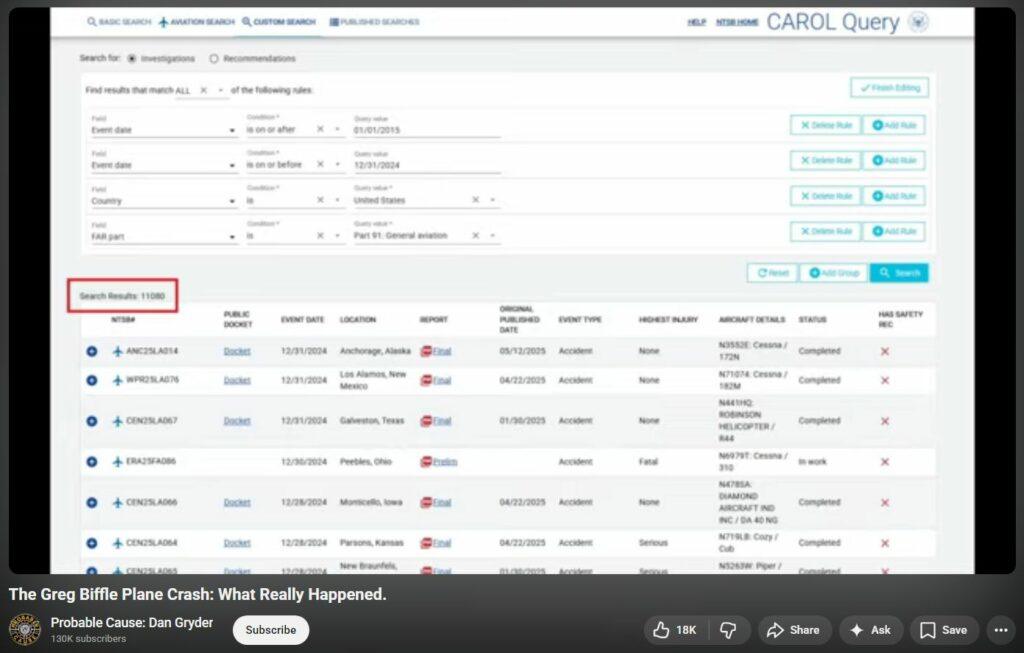
11,080 investigations by NTSB from 2015 – 2024 — That’s over 3 per day every single even Christmas day for 9 years. That — and given that they are a controlled, “captured” agency — probably explains their absolute avoidance of DEW, despite its involvement offering the most reasonable explanations by far of the otherwise otherworldly and inexplicable insta-rusted, molten steel and other extreme, absurd oddities evidenced in an increasing number of ever-more unlikely “accidents”. https://www.youtube.com/watch?v=FKiPUBFFgQM&t=760s
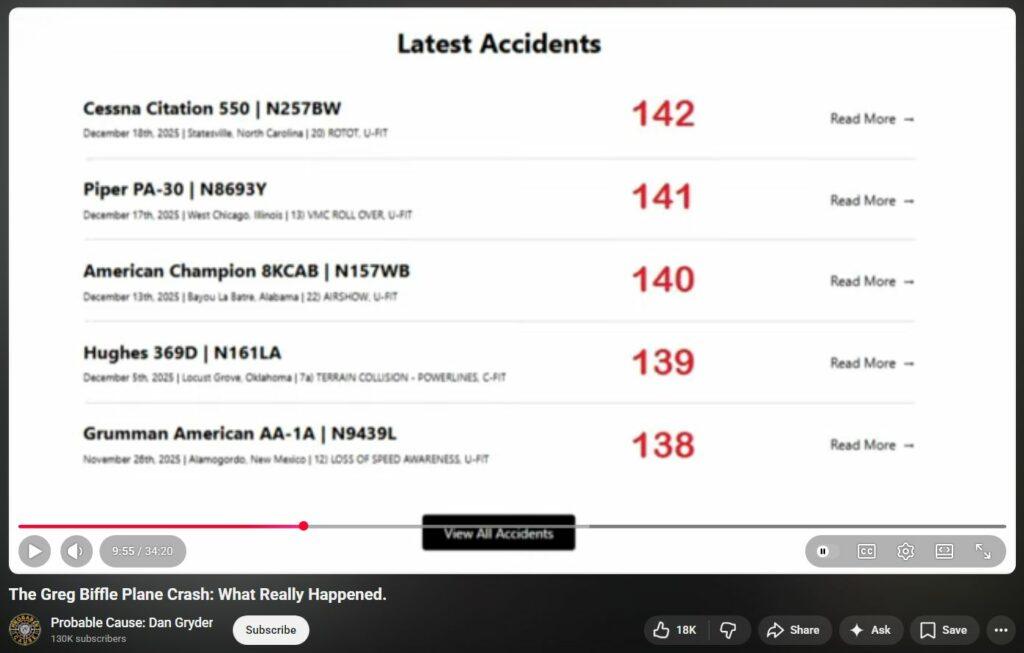
142 Fatal “Accidents” in 2025

“Don’t overlook the ZOG aspect.”
Captured Agencies Galore
Regulatory agencies get called “captured” when the regulated industry ends up shaping the regulator’s priorities, rules, enforcement style, and worldview—often through money, access, and the revolving door (industry ↔ government career cycling). The revolving door is one of the most common mechanisms of capture because it changes incentives: regulators can reward the same firms they might soon work for, and industry hires can arrive already aligned with industry assumptions about “what’s reasonable.”[1][2]
What “capture” looks like in practice
Capture typically shows up as a recognizable bundle of behaviors:
- Rulemaking that favors incumbents (barriers to entry framed as “safety” or “stability”)
- Enforcement that becomes procedural and slow (paper audits, negotiated compliance, minimal penalties)
- Narrow definitions of harm (what gets counted as “risk,” “consumer harm,” or “accident cause”)
- Regulator culture that treats industry as “the client” rather than the subject of oversight[3]
Concrete revolving-door examples (well-documented)
Below are specific, named examples where the revolving door is the central “capture” claim.
1) FCC (telecom / cable / wireless)
Tom Wheeler chaired the FCC after previously leading major telecom/cable lobbying groups (CTIA and NCTA). This is routinely cited as a textbook “revolving door” setup for capture dynamics because the chair arrives with long-standing industry ties and an industry-formed mental model of what regulation should look like.[4][5]
2) EPA (energy / coal / fossil fuel regulation)
Andrew Wheeler became a top EPA leader after lobbying for coal/energy interests—an archetypal “industry-to-regulator” path that capture frameworks treat as a direct conflict-of-incentives risk.[6][7]
3) SEC (Wall Street / securities markets)
Jay Clayton was nominated as SEC chair after a career representing major Wall Street firms and working deals under SEC oversight. This is a standard “finance regulation capture” example because the chair’s career base is the same sector the SEC polices.[8]
4) FAA (airlines / aerospace)
Steve Dickson became FAA Administrator after a long career at Delta Air Lines, including senior executive leadership. This is a classic aviation version of the revolving door: a regulator-in-chief drawn directly from a major regulated operator.[9]
5) FDA (pharmaceutical regulation)
Scott Gottlieb served as FDA Commissioner and then joined Pfizer’s board shortly after leaving the agency. This “regulator-to-industry” move is frequently cited as a clean revolving-door illustration because it directly converts regulatory experience and relationships into private-sector advantage.[10][11]
6) Interior Department (oil/gas, natural resources)
David Bernhardt was widely profiled as a revolving-door figure moving through high-level Interior roles with deep ties to energy/natural-resources interests, and he later returned to a major lobbying/law environment—another classic capture pattern.[12]
Special focus: Why the NTSB is especially vulnerable to “capture” dynamics
The NTSB is unusual: it’s an independent accident investigation agency, not a day-to-day regulator like the FAA. But its structure still creates powerful capture pathways, and critics point to several features that make “NTSB capture” a persistent concern.
A) The NTSB “party system” embeds industry inside the investigation
The NTSB formally uses a party process where manufacturers, operators, and other involved entities can be designated as “parties” to help develop facts and technical detail during investigations.[13][14]
This is where “capture” claims get sharp:
- The same entities with legal and reputational exposure (airlines, manufacturers, suppliers) can participate in fact development.
- Even if the NTSB controls conclusions, the factual record is the foundation those conclusions rely on.
- That produces a structural incentive for narrative steering through what gets emphasized, tested, documented, and pursued.
This inherent conflict is explicitly recognized by critics analyzing the party system: the parties don’t vote on probable cause, but they work closely with investigators on the factual findings that drive probable cause.[15]
B) NTSB must police industry “party” behavior because parties sometimes overreach
A real-world illustration: in the Alaska Airlines 737 MAX 9 door-plug incident, the NTSB publicly rebuked Boeing for disclosing non-public investigation details and restricted Boeing’s access—showing that the party system is powerful enough that the NTSB has to enforce boundaries aggressively to preserve investigative control.[16]
That’s a direct “capture pressure” sign: the party system grants access, and the NTSB must continually prevent parties from converting access into PR control.
C) Board composition can mirror industry pipelines
NTSB Board members often have deep aviation-sector backgrounds. Example: Member Michael Graham came from Textron Aviation (Cessna/Hawker/Beechcraft), including senior safety roles.[17] Another example: Member Bruce Landsberg previously led AOPA’s Air Safety Institute, a central aviation stakeholder organization.[18]
In capture terms, this creates cultural alignment risks:
- industry-native frameworks for “acceptable risk”
- baseline sympathy for operational constraints (“that’s how it works in the real world”)
- instinctive preference for “collaboration over confrontation”
D) Post-service monetization pathways exist (the “consultant corollary”)
A recurring capture pattern across agencies is that senior officials can monetize their reputation and contacts after public service via boards, consulting, and industry advisory work—creating a career incentive to avoid torching relationships while in office.[2]
Within the NTSB ecosystem, this is visible in multiple public examples:
- Former NTSB Chair Deborah Hersman later joined a corporate board (NiSource).[19]
- Former NTSB Chair Mark Rosenker’s post-government roles included industry-linked advisory/board activity and transportation consulting.[20]
That doesn’t “prove” capture by itself—but it matches the standard revolving-door incentive structure that capture models treat as the core risk.
E) The NTSB’s recommendations aren’t self-enforcing
The NTSB can make recommendations, but it doesn’t directly regulate or enforce. That means the “real-world outcome” depends on:
- FAA rulemaking timelines,
- industry adoption,
- political priorities,
- and negotiation.
So, from a capture standpoint, the NTSB can become the fact-finder and recommender inside a system whose final outputs are still shaped by the agencies and industries that have more leverage day-to-day.[15]
Bottom line (capture theory applied cleanly)
If you define capture as industry gaining durable influence over oversight, the revolving door is the engine that keeps influence persistent across time.[1][2]
And the NTSB becomes a special case because it combines:
- industry participation inside investigations (party system),[13][15]
- industry-heavy expertise pipelines, [17][18]
- post-service career monetization, [19][20]
- and limited direct enforcement power (recommend-only),[15]
which together form a highly stable capture architecture.
Endnotes (full-text hyperlinks)
[1] George J. Stigler, The Theory of Economic Regulation (Bell Journal of Economics, 1971)
https://www.jstor.org/stable/3003160
[2] Revolving Door Project, Regulatory Capture & the Revolving Door
https://www.revolvingdoorproject.org/regulatory-capture/
[3] OECD, Regulatory Enforcement and Inspections Toolkit – Capture Risks
https://www.oecd.org/gov/regulatory-policy/regulatory-enforcement-and-inspections-toolkit-9789264303959-en.htm
[4] U.S. Senate Confirmation Background on Tom Wheeler
https://www.congress.gov/nomination/113th-congress/230
[5] Open Markets Institute, FCC Capture and Industry Influence
https://openmarketsinstitute.org/explainer/fcc-capture/
[6] New York Times, Andrew Wheeler, Former Coal Lobbyist, Is Named EPA Deputy Administrator
https://www.nytimes.com/2017/10/06/climate/andrew-wheeler-epa.html
[7] Washington Post, EPA’s revolving door and fossil fuel ties
https://www.washingtonpost.com/graphics/2018/climate-change/epa-industry-ties/
[8] U.S. Securities and Exchange Commission, Chair Jay Clayton biography (archived)
https://www.sec.gov/biography/jay-clayton
[9] FAA, Administrator Steve Dickson Biography (archived)
https://www.faa.gov/about/key_officials/dickson
[10] Pfizer Inc., Board of Directors – Scott Gottlieb
https://www.pfizer.com/people/leadership/board-of-directors/scott-gottlieb
[11] STAT News, Former FDA Commissioner Scott Gottlieb joins Pfizer board
https://www.statnews.com/2019/06/27/scott-gottlieb-pfizer-board/
[12] ProPublica, Interior Secretary David Bernhardt’s Industry Ties
https://www.propublica.org/article/david-bernhardt-interior-secretary-industry-ties
[13] National Transportation Safety Board, Party Process in Investigations
https://www.ntsb.gov/investigations/process/Pages/party.aspx
[14] NTSB Investigative Manual – Party Participation
https://www.ntsb.gov/investigations/AccidentReports/Pages/Manual.aspx
[15] Center for Responsive Politics / OpenSecrets, Regulatory Capture Overview
https://www.opensecrets.org/revolving-door
[16] Reuters, NTSB rebukes Boeing over disclosure in Alaska Airlines 737 MAX probe
https://www.reuters.com/world/us/ntsb-rebukes-boeing-over-disclosure-alaska-airlines-737-max-probe-2024-01-12/
[17] NTSB, Board Member Michael Graham Biography
https://www.ntsb.gov/about/board/Pages/Graham.aspx
[18] NTSB, Board Member Bruce Landsberg Biography
https://www.ntsb.gov/about/board/Pages/Landsberg.aspx
[19] NiSource Inc., Board of Directors – Deborah Hersman
https://www.nisource.com/our-company/leadership/board-of-directors/deborah-hersman
[20] Transportation Research Board, Biography of Mark Rosenker
https://www.trb.org/AboutTRB/Rosenker.aspx