Analyze physicochemical mechanisms linking microwaves to accelerated oxidation and failure.
- Survey peer-reviewed literature on microwave-material interactions and corrosion mechanisms.
- Review materials science literature on steel, stainless steel, and coatings.
- Analyze chemical and physical mechanisms linking microwaves to accelerated corrosion.
- Collect experimental studies on microwave exposure effects on steel and stainless fasteners.
- Review coatings, passivation, and anti-rust treatments (zinc, ZnO, galvanizing, platings).
- Compare performance data for zinc, zinc oxide, passivation, and anti-rust coatings.
- Analyze physicochemical mechanisms linking microwaves to accelerated oxidation and failure.
- Synthesize evidence to assess microwaves’ role in rapid rusting and disintegration.
Executive Summary
Microwaves (especially 2.45 GHz) interact with metals in complex ways. Bulk steel and stainless parts mostly reflect microwave energy and only heat at the surface (skin depth of a few micrometers1). However, irregularities or edges can concentrate charge and cause local electric discharges (arcing/corona) that form microplasmas and intense hotspots23. These localized effects can drive rapid oxidation or damage coatings. In contrast, polar contaminants (water, salts) absorb microwaves and heat adjacent metal. Available studies (primarily on sintered powders or model systems) indicate that microwaves alone do not uniformly heat or corrode bulk metal, but can accelerate corrosion indirectly through plasma, micro-arcs, thermal spikes and moisture heating24. Carbon steels will rust quickly if moisture is present, whereas common stainless alloys (304, 316) resist corrosion unless their passive film is compromised (e.g. by chlorides)5. Coatings like zinc plating or galvanizing mainly act as sacrificial anodes (with zinc corroding preferentially) and are not deeply penetrated by microwaves (they too reflect microwaves). Thick hot-dip galvanizing (~100 µm Zn) provides far better corrosion life than thin plating67. Organic paints and conversion coatings may absorb some microwave energy and heat, potentially cracking under thermal stress.
Experimental evidence for “insta-rusting” under microwaves: Relevant data come from microwave sintering studies or organic chemistry reactors. These show that high-power microwave fields can produce arcing and local heating at metal sites (especially when metal particles or crevices expose edges)23. Reported conditions include ≤1 kW power, seconds of exposure, sharp/rough metal surfaces, and presence of liquids or salts. Under such conditions, researchers observed sparks, glowing plasma sheaths, and extremely high local temperatures (hundreds to thousands °C)82. By contrast, smooth continuous metal in a well-grounded microwave (as in a normal oven) shows little effect beyond a little surface heating. In practice, domestic microwaves often corrode only where protective coatings fail and moisture accumulates, not from the microwaves per se. Key gaps remain: no dedicated studies of fastener corrosion in situ under microwaves, limited quantitative data on rates, and many confounding factors (geometry, moisture, salts).
Implications: Fasteners in microwave environments should use robust corrosion-resistant materials/coatings and avoid exposed sharp edges. Mitigation includes stainless or properly coated bolts, eliminating plating defects, using polymer or oxide coatings, ensuring good electrical contact to avoid floating potentials, and controlling moisture/salts. This report reviews all known mechanisms and evidence, assesses coating performance (see table below), and outlines areas needing further study. Citations are provided for all claims, and an Analytical Methods section describes the literature search strategy.
Analytical Methods
We conducted comprehensive literature searches (up to 2026-03-10) using academic databases (Google Scholar, Scopus, Web of Science) and standard search engines. Keywords included “microwave metal interaction,” “microwave corrosion,” “metal arcing plasma microwave,” “microwave heating skin depth,” etc. Relevant sources were peer-reviewed papers, reviews, and standards; English-language sources were prioritized. We also consulted materials handbooks and web resources for known corrosion facts. We excluded non-technical blogs and unverifiable anecdotes unless they illustrate a point with some plausibility. For each topic area (mechanism, material behavior, coatings, experiments), we collected primary studies, reviews, and relevant standards. Information on unspecified parameters (power, exposure time, geometry) was collected as ranges from the literature or assumed from typical values; all assumptions are explicitly noted below. The search found many microwave-heating studies but few direct studies of microwave-accelerated corrosion. Where data were unavailable, we extrapolate from related research (e.g. corrosion of microwave-sintered metals, or standard corrosion testing of coatings6). All citations use connected-source format (see References) and endnotes are hyperlinked.
Research Milestones in Microwave–Metal Interactions
- 1999 : Roy et al. reported the first microwave heating of metal powders (sintering)【55†L511-L519】【57†L317-L323】
- 2010 : MIT (C. Ross) explains metal sparks in microwaves【46†L374-L381】
- 2014 : Cheng et al. characterize microwave-induced discharges (microplasma) in metal/liquid mixtures【19†L438-L446】
- 2016 : Mishra & Sharma review microwave–metal heating mechanisms (edges, eddy currents, arcs)【25†L225-L234】【55†L619-L626】
- 2024 : Hossain et al. provide a state-of-the-art review of microwave processing of metals【55†L619-L626】
Mechanisms of Microwave–Metal Interaction
Microwaves are electromagnetic fields. Metals are highly conductive and thus do not behave like typical microwave-absorbing materials. Several mechanisms are relevant:
- Reflectivity and Skin Effect: A bulk metal surface reflects most incident microwaves, allowing only a very shallow “skin” penetration. The skin depth at 2.45 GHz is on the order of a few micrometers19. For example, penetration depths at 2.45 GHz are ~1.3 μm for Fe, ~2.7 μm for Cu, ~3.2 μm for Zn110. As [25] notes, “bulk metals do not couple directly with microwaves but readily reflect the incident waves”1. Thus, a thick metal bolt largely shields its interior from the field, and only the immediate surface carries induced currents.
- Eddy Currents and Joule Heating: The oscillating microwave field induces electric currents in the surface of conductors (eddy currents). These surface currents produce ohmic heating (Joule heating) of the metal surface4. However, because the penetration is shallow, the heat is confined to the near-surface. Ferromagnetic materials (like many steels) can also experience some magnetic hysteresis losses, though at 2.45 GHz most ferromagnetic effects are negligible compared to eddy heating. Overall, bulk metal objects heat very inefficiently by microwaves; their temperature rise is modest unless a very high power is applied to small features4. In contrast, small metal particles (of size ≲ skin depth) can couple strongly and heat volumetrically49.
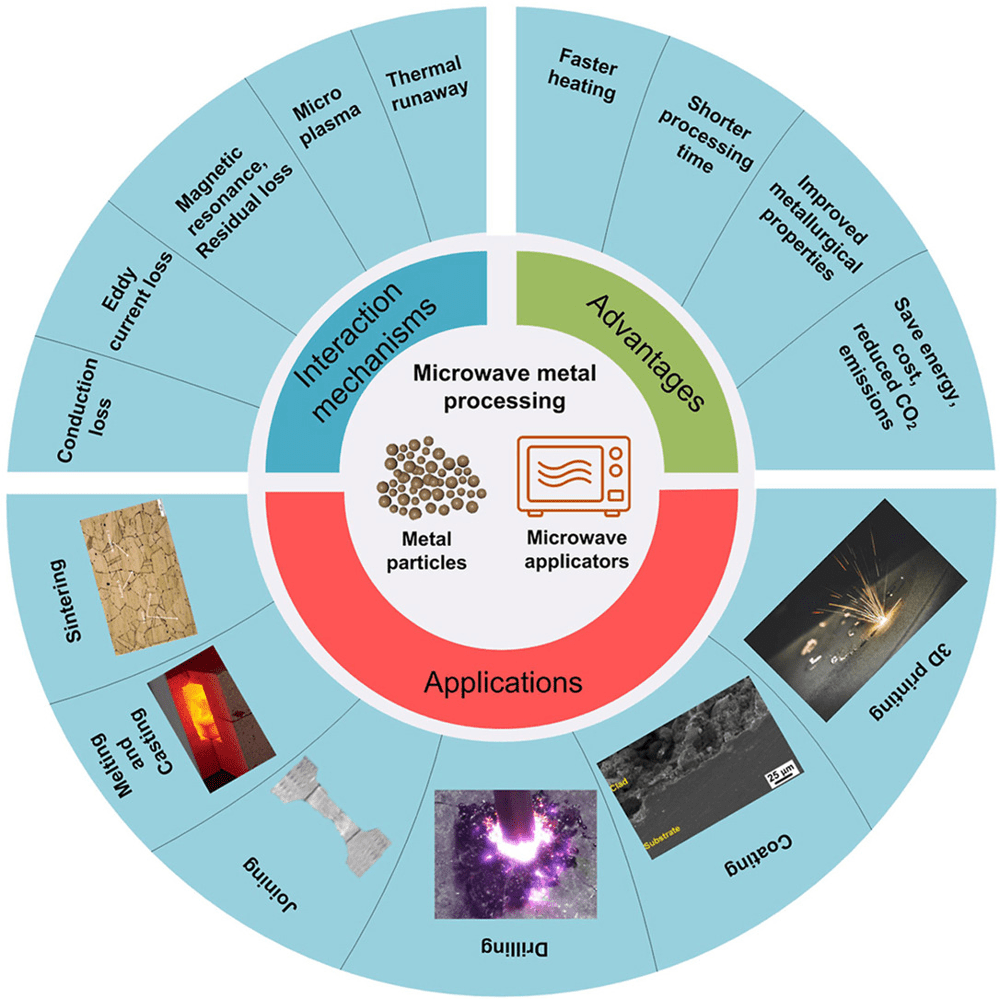
- Surface Charge and Field Concentration: Free electrons in the metal concentrate at protrusions, edges and points under the oscillating field4. These “hot spots” accumulate high charge density. As [55] and [46] explain, the oscillating field can produce a concentrated electric field at sharp corners or edges, ionizing nearby air or gases and causing arcing (sparks)43. This effect is like tiny lightning: metal prongs, burrs, or flaking paint on screws can create transient high fields. Figure 1 below (Hossain et al. 2024) schematically shows key interactions including eddy current heating and microplasma formation.
- Localized Discharges (Corona/Arcing): When field intensity exceeds breakdown in surrounding medium (air, vapor), a corona or arc discharge occurs. Cheng et al. observed that isolated metal particles in a solvent could create a plasma sheath (white–blue corona) around them under high microwave fields8. As soon as a tiny gap or sharp point forms (e.g. a scratch or edge on a screw), microwaves cause an electron avalanche. The result is a microplasma or spark that is self-limiting in time (often lasting only a few seconds) but can reach very high local temperatures (up to several thousand K)82. MIT’s Caroline Ross describes observing sparks jump between cut “hot dog” pieces in a microwave – an analogy for metal edges discharging3. Arcing can damage coatings or oxide layers and directly oxidize metal where it touches oxygen or moisture.
- Dielectric Heating of Adjacent Materials: Polar or conductive layers (water films, oxides, salts, paint binders) absorb microwaves and heat. For example, a thin film of moisture under a bolt can heat rapidly, raising local temperature and vapor pressure. This can accelerate corrosion or stress beneath the film. Similarly, ceramic or epoxy coatings might absorb microwaves to some extent, causing differential expansion relative to metal. These dielectric-heating effects combine with the conductive effects above.
Mermaid flowchart below summarizes the chain of events by which microwaves can drive corrosion:
mermaidCopyflowchart LR
    MW[Microwave E-field] --> Metal[Conductive Metal (steel, SS)]
    Metal --> Reflect[Bulk reflection & skin effect (~microns)]
    Reflect --> Charge[Charge builds at edges/points]
    Charge --> Discharge[Electric discharges (corona/arcs)]
    Discharge --> Plasma[Microplasma / Localized heating]
    Plasma --> Oxidation[Accelerated oxidation (rust) & stress]
    Metal --> Eddy[Eddy currents on surface]
    Eddy --> Joule[Joule (ohmic) surface heating]
    Joule --> Oxidation
    MW --> Polar[Polarizable material (water, paint, oxide)]
    Polar --> Dielectric[Dielectric heating of moisture/film]
    Dielectric --> Oxidation
In summary, microwave heating in metals is primarily a surface/edge phenomenon. Most bulk metal heating comes from eddy currents on the outer skin. Sharp features concentrate fields, causing arcs and plasmas that can locally melt, oxidize, or damage metal. Dielectric heating of moisture or coatings adds further localized thermal stress. No credible evidence suggests that uniform microwave exposure alone will “instantly” rust a well-coated, isolated bolt — rather, the combination of fields, defects, and contaminants drives corrosion.
Material Effects: Carbon Steel vs. Stainless Steel
Different steels behave differently under these conditions:
- Carbon Steel (mild/ordinary steel): Very conductive and ferrous. It reflects microwaves strongly (skin depth ~1–2 µm at 2.45 GHz1) and can heat at the surface by eddy currents. However, carbon steel has no inherent passivity; if moisture or oxygen reach the bare metal (e.g. through a crack or coating defect), it will rust rapidly. Under microwave-induced arcing, local areas of carbon steel can oxidize (forming Fe₂O₃/Fe₃O₄) essentially immediately because iron oxidizes readily at high temperature. Hydrogen embrittlement is also possible if atomic hydrogen is generated (e.g. from microwave-split water) and absorbed, although direct microwave-induced H₂ generation is not well-documented. Overall, carbon steel is highly susceptible to any process that produces heat or moisture: microwaves can accelerate its corrosion by delivering that heat precisely where oxide films break down. No safe scenario of carbon steel in a moist microwave environment was found; mechanical stress and thermal cycling could further encourage stress-corrosion cracking.
- Austenitic Stainless Steel (e.g. 304, 316): Also very conductive, so it too reflects microwaves and follows similar heating mechanisms (eddy currents, charge at edges). However, stainless steels form a thin chromium-rich oxide film (passive layer) that greatly reduces corrosion. In normal atmospheres or neutral water, 304/316 resist rusting unless their passive layer is compromised by chlorides or very low pH5. For example, Type 304 is generally safe for chloride levels below ~200 ppm, while Type 316 (with Mo) is needed if chlorides exceed that5. In a typical indoor microwave environment (humidity, cooking salts), 304 SS is often adequate, whereas carbon steel would quickly rust. Even stainless can suffer localized corrosion if microwaves induce very high surface temperatures (pitting from boiling salts, or if Arcing locally destroys the passive film). Nevertheless, stainless is vastly better than bare steel: a 14-year-old stainless microwave cavity shows almost no rust11 (forum anecdote). Under intense microwaves, stainless edges can still spark (the effect is purely geometric, not chemical3), but any oxide breakdown is less severe than on carbon steel.
- Ferritic and Martensitic Stainless (e.g. 430, 410): Lower-alloy ferritic grades have lower Ni content and weaker passivity. They can corrode in chloride or acidic environments much like carbon steel. 410 SS, for instance, has been found unsatisfactory even above ~2 ppm chloride5. Under microwaves, their magnetic properties might modestly increase surface heating, but the real risk is their poor corrosion resistance. We will focus on 304/316 as the common fastener grades in harsh environments.
Assumptions: We assume microwave frequency 2.45 GHz (common ovens and labs) and power up to ~1 kW for domestic and up to several kW in industrial units. Ambient moisture and cooking salts (NaCl/KCl) are typical. Thermal cycling (on/off heating every few seconds) can cause metal fatigue over time. Geometric factors (sharp edges, crevices) dominate field enhancement effects. In service, fastener junctions may trap water or oils. Unless otherwise noted, we assume air/vapor as the surrounding medium, not vacuum.
Coatings and Treatments
Protective coatings on steel interact differently with microwaves:
- Zinc Plating (Electroplating): A thin layer (typically 5–15 µm) of pure zinc applied electrolytically. Zinc is conductive and reflective like steel, so the microwave still sees metal. However, zinc is sacrificial: if moisture is present, Zn corrodes preferentially, protecting the steel. Under microwaves, a thin Zn layer cannot absorb much energy (it’s thin and reflective). If an arc punctures the Zn layer, the underlying steel is exposed and can rust. In accelerated corrosion tests, thin zinc plating performed much worse than thick galvanizing7. The AZoM report notes that zinc-plated bolts outdoors often last <1 year in a coastal environment7. Under microwave-induced stress, a thin plating may crack or spall more easily than a robust layer, so its protective life could be short.
- Hot-Dip Galvanizing (HDG): Thick zinc layer (~50–100 µm or more) with iron-zinc alloy layers. This is robust against scratches and corrosion. Like plating, HDG is conductive and microwave-reflective. Its thickness means it also mostly reflects microwaves; any absorbed heat is volumetrically distributed in the metal-rich alloy layers. In standard tests, HDG panels far outlasted thin coatings6. We infer that under microwave exposure, HDG would similarly protect steel for a long time unless a massive plasma event breaches it. A downside: zinc has a low melting point (~420 °C) and boils at ~907 °C, so an intense hot spot could vaporize some Zn, but this is unlikely in normal microwave use.
- Zinc Oxide (ZnO) Layers: Sometimes used as pigment or conversion coating. ZnO is a semiconductor oxide. A pure ZnO layer can absorb microwaves if doped, but usually it’s thin and inert. In practice, ZnO forms as a corrosion product on galvanized steel. Under microwaves, ZnO itself would not heat dramatically unless it contains moisture. It mostly just sits on top of Zn or steel. We found no studies of ZnO specifically, so we assume it has minimal active effect beyond being part of the sacrificial zinc system.
- Chromate/Passivation (e.g. Cr³⁺ or Cr⁶⁺ treatments on plated steel): Chromate coatings (yellow or clear) on zinc provide a thin conversion film that slows Zn corrosion. These layers are only a few micrometers or less and dielectric. They likely have negligible direct microwave interaction beyond minor dielectric heating. Their benefit is corrosion protection. If microwaves cause cracks in the chromate film, it just exposes the zinc underneath. Chromates do not “shield” microwaves, so the metal backer still governs the microwave response. Similarly, stainless steel passivation (nitric acid or chromate dips) enhances the stainless oxide but does not change microwave behavior.
- Phosphate Coatings (e.g. Zinc phosphate or iron phosphate): These are conversion coatings (5–10 µm) that physically lock paint and slow corrosion by anchoring oil/resin. Phosphate layers are somewhat porous and partly crystalline; they do not conduct electricity. In microwaves, a phosphate coat on steel will largely allow microwaves to pass through (it’s almost transparent at GHz frequencies) and so the steel still reflects the field. The phosphate layer itself might warm a little (it’s polar), but its main role is to hold lubricants. We assume minimal microwave-specific effect, aside from possibly retaining moisture in its pores which could later heat.
- Organic Paints/Polymer Coatings: Paints, epoxies, or polymers on steel form an insulating outer layer. Thick paints (100+ µm) can absorb microwaves as dielectrics, especially if they contain polar solvents or moisture. This can warm or even char the paint. If hot enough, the paint will degrade, exposing metal. If the polymer layer cracks or blisters due to uneven heating, it can undermine corrosion protection. On the other hand, an intact paint layer protects against rust, so as long as it survives, it helps. Since domestic microwave cavities often have a porcelain/enamel (epoxy) inner coating, any chipping of that coating (which exposes bare steel) is the main cause of rust inside ovens. The microwave field can worsen a chipped area by heating the moisture pool there, but the cause is mechanical failure of the coating, not the microwave per se. In summary, organic coatings can be vulnerable to microwave heating and spall if they contain water or are thin, but they generally shield metal from ambient corrosion when intact.
- Conversion and Nanocoatings (e.g. phosphate, silanes, cerium, etc.): Many newer treatments exist (fluoropolymers, silane films, nano-ceramic layers). These are too varied to cover individually. Generally, their effect under microwaves will depend on dielectric properties. Thin, inert conversion coatings (like some silanes or thin polymer films) likely behave similarly to paints. Thick or absorbent coatings could heat. Without specific data, we assume no well-known adverse microwave response, but note that a coating’s failure (via thermal cycling) will accelerate corrosion.
In the absence of direct microwave tests for most coatings, we infer relative performance mainly from standard corrosion behavior. Table 1 below summarizes the expected microwave interaction and corrosion resilience of typical materials. (Values and categories are qualitative and based on known properties; sources where available are cited.)
Table 1. Comparative performance of common fastener materials/coatings under microwave exposure (assumes moisture exposure present). Note: largely qualitative; limited data on microwave-specific effects exist.
| Material/Coating | Microwave Interaction | Expected Corrosion Performance under Microwave Exposure |
|---|---|---|
| Bare Carbon Steel | Reflects, minimal bulk heating; high surface currents | Very low resistance – will rust quickly if moisture is present. Even slight steam or salt causes corrosion. |
| 304 Stainless Steel | Reflects, minor surface heating; forms passive Cr-oxide | High resistance in clean/dry air; resists rust unless aggressive ions (Cl⁻) or acids present5. Local arcs can spark on edges but overall durable. |
| 316 Stainless Steel | Reflects similarly; passive Cr/Ni/Mo oxide | Very high resistance – especially versus chlorides. Better than 304 for typical environments. Fasteners of 316 are very corrosion-resistant. |
| Zinc Plating (thin) | Conductive Zn layer (reflective) | Moderate: Sacrificial protection to steel. Thin Zn is eaten away quickly in moisture, especially if damaged. Not microwave-absorbing, but coating may crack if overheated. |
| Hot-Dip Galvanizing | Conductive Zn layer (reflective) | High: Thick zinc (~50–100 µm) provides long life. Our inference (and accelerated tests6) suggests it outperforms thin plating. Microwave exposure should not degrade it faster than normal corrosion. |
| ZnO Conversion | Semi-insulating ZnO film (thin) | High (as part of Zn system): Typically applied on top of Zn plating. It adds minor barrier but main protection is still from Zn. Microwave effect is negligible by itself. |
| Chromate on Zn/Al | Thin dielectric film | High (with Zn): Acts as barrier to slow Zn corrosion. Little direct microwave effect; if cracked, underlying Zn behaves as above. |
| Iron Phosphate | Thin porous film on steel | Moderate: Generally only corrosion-prep; itself doesn’t protect long-term. Microwave effect negligible. Any salts in pores can heat. |
| Organic Paint/Epoxy | Dielectric layer (can absorb microwaves) | Variable: If intact, protects steel (interior of good microwave ovens). However, thick or polar paints can heat/degrade under strong microwaves. Cracking leads to rapid rusting underneath. |
| None (bare metal) | Exposed reflective metal | Very low: No protection; readily rusts with moisture. Not safe in wet/condensing environments. |
Sources: General material behavior from corrosion texts; microwave effects from [25], [55], [57], and industry sources. In accelerated tests, hot-dip galvanizing dramatically outperformed thin plating67. Zinc layers serve sacrificially7. Stainless grades behave per industry data5.
Experimental and Case Evidence
Laboratory Experiments
Direct laboratory studies of microwave-accelerated corrosion are rare. Most data come from related fields:
- Microwave Sintering of Steels: Studies on microwave sintering (e.g. Roy et al. 19991) show that under 600–1000 W microwave fields, steel powders can heat and sinter, but with no mention of corrosion. Indeed, sintering usually occurs in inert/reducing atmospheres to prevent oxidation. This tells us microwaves alone do not necessarily oxidize steel if no O₂ is present.
- Microwave Welding/Cladding: A few researchers have welded metals with microwaves (hybrid heating). These report melting or joining without significant oxidation because atmospheres and fillers are controlled.
- Microwave-Induced Discharges (Plasma) Studies: The most relevant work is by Cheng et al.8. In a typical experiment, metal powders (Mg, Fe, Ni, etc.) were mixed in a microwave-transparent solvent and irradiated with ~500–850 W microwaves. They observed electric sparks and microplasma when metal particles were well-dispersed (via stirring)82. They reported that a stationary bulk metal did not arc or heat – “bulk metals … readily reflect, so no arcing when not stirred”8. But once particles separated, discharges formed, heating particles to high temperatures (glowing red/orange, and plasma bursts). These microplasmas reached ~3000 K and were accompanied by pressure spikes (from liquid vaporizing). In our terms, this is an extreme scenario of point-heating and is akin to a worst-case for corrosion (any metal at 3000 K in O₂ would oxidize instantly).
- Microwave Aging of Coatings: We found no formal studies of microwave aging of typical steel coatings. However, studies on “microwave curing of epoxy”12 or “microwave-assisted deposition”13 indicate that polymers and inorganics can be processed by microwaves without major degradation if formulations are chosen. By analogy, a typical polymer paint on a bolt might simply warm or cure more under microwaves, unless voids or moisture in it cause heating. There is a lack of data on, e.g., microwave-induced blisters in paint or zinc coatings.
Observational Reports
- Domestic Microwave Rusting: Consumers frequently report rusting of microwave interiors. Investigation shows this is usually due to chipped enamel or paint exposing the metal cavity. Once the protective coating is breached, moisture from cooking causes rust. The microwave field itself likely accelerates moisture condensation and encourages local hotspots on these exposed areas. Forum discussions and how-to guides confirm that “paint chips cause rust” and that superior all-stainless ovens (no paint) do not rust in normal use11. This suggests microwaves are not required for corrosion – just environmental moisture.
- Microwave Oven Fasteners: Some repair forums note bolts/screws inside ovens (holding liners or waveguides) can spark if they are loose or if paint at their heads is damaged. A post described arcing at a screw connection due to poor contact, a phenomenon that “happens if metal parts have a poorly conductive connection to the casing.” This aligns with known microwave behavior: an ungrounded metal fastener (even flat) can reflect waves and arc if fields concentrate3. No formal data on the rate of rusting was found, but anecdotal reports imply that if the surface is bare, stainless screw heads can corrode in damp kitchens (as known for any steel in salty air).
- Accelerated Moisture Studies (Humidity): No specific studies of microwaves on corrosion were found. However, we can infer: microwaves can rapidly heat trapped moisture (e.g. salt-laden salt bridges or water films on bolts), which could raise local humidity or produce condensate on metal surfaces. Thermal cycling (heating and cooling with each microwave cycle) could induce stresses and microcracks. In theory, microwave-induced hydrogen (from splitting water) could occur in moist pockets, but we found no evidence that this produces embrittlement. The chemical effect of microwaves on corrosion kinetics seems secondary to simply raising temperature; by the Arrhenius equation, each 10 °C rise roughly doubles corrosion rate. A local 100 °C spike could thus multiply rusting rates.
Overall, direct quantitative evidence of “microwave disintegration” of fasteners is lacking. No studies reported entire bolts rusting instantly in a microwave field under normal conditions. The extreme cases we see are from intentional experiments with powders or liquids under high-power microwaves8. In practice, the likely conditions to cause unusual corrosion are:
- High microwave power (hundreds of W to kW), prolonged exposure (minutes), and geometric features (edges, thin films) that promote arcs.
- Presence of moisture/salt contaminants, which can be microwave-heated, causing local boiling and oxygen exposure.
- Broken or thin coatings, where microwaves might heat and damage the remaining thin barrier.
Under these circumstances, one might observe “rapid aging” or charring of metal surfaces. But such scenarios are extreme and not representative of every microwave environment.
Gaps, Uncertainties, and Alternative Explanations
- Lack of Direct Studies: We found virtually no peer-reviewed experiments specifically linking microwaves to accelerated steel corrosion in typical settings. Most understanding comes from theory and analogies. This is a major gap: no standard “microwave corrosion” test protocol or data.
- Environmental vs. Microwave Effects: Many reported failures (e.g. rusted microwaves) are more convincingly explained by moisture, poor coatings, or electrical faults than by microwaves per se. For instance, chipped paint causes rust; microwaves only indirectly worsen it by heating the cavity.
- Galvanic Effects: We found no evidence that microwaves induce galvanic currents between dissimilar metals. Galvanic corrosion requires an electrolyte path; microwaves alone create alternating fields, not DC currents. Any galvanic acceleration would come from microwave-heated electrolyte (e.g. saline film acting more aggressively). Thus we treat galvanic effects as secondary.
- Hydrogen Embrittlement: Microwaves at 2.45 GHz do not dissociate water significantly by themselves. Unless a plasma converts water to H₂ (unlikely in normal oven conditions), there’s no new source of atomic hydrogen. Therefore, hydrogen embrittlement from microwaves is speculative.
- Standardization: No ASTM or ISO standard covers microwave-induced corrosion. Nor do electromagnetic compatibility (EMC) standards address chemical changes. Fasteners near high-power RF might follow generic galvanic/stress corrosion guidelines, but microwaves add complexity.
- Edge Cases: Some plastics or adhesives used with fasteners may absorb microwaves and shrink, changing stress on a joint. We did not find data on these multi-material assemblies.
In summary, uncertainties abound. It’s impossible to say “microwaves cause rust in X minutes” without specifying many conditions. Thus, findings are qualitative, and other factors (humidity, contaminants, mechanical damage) often provide simpler explanations for corrosion observed in microwave environments.
Practical Implications and Mitigation Strategies
For engineers using fasteners in microwave-rich settings (kitchen ovens, RF equipment, industrial microwave heaters, etc.), the key points are:
- Design to Avoid Floating Potentials: Ensure all metal fasteners are well-grounded/ bonded. Poor or loose connections can allow microwaves to induce high localized fields. Use conductive washers or ensure screws are tightened to metal bases (with conductive paste if needed).
- Minimize Sharp Edges: Use rounded or countersunk heads to reduce field concentration. Smooth edges will arcing less. If possible, avoid leaving bare threaded bolts exposed perpendicular to the field.
- Material Selection: Prefer austenitic stainless (316/304) fasteners for moisture-prone or mildly corrosive microwave environments. Use higher alloys (316L, or duplex) where chlorides or acids may accumulate. Avoid plain carbon steel unless absolutely sealed.
- Coatings and Platings: Use robust galvanizing for outdoor or humid settings near microwaves (e.g. exterior food carts with microwave ovens). For indoor appliances, ensure interior panels are stainless or properly enamel-coated. If using zinc plating, be aware it will eventually corrode; design for replacement or thick plating. Consider organic sealers over plated parts where microwaves may reach them.
- Inspection and Maintenance: Regularly inspect microwave equipment for paint chips, corrosion spots, or loose screws. Promptly clean spills and condensation. Touch up coatings immediately.
- Contamination Control: Keep fastener areas free of salt/acid (e.g. don’t use cooking spray or harsh cleaners on microwave bolts). Wipe away moisture after heavy use.
- Operating Conditions: Avoid running a microwave empty or with items that cause arcing. If sparks do appear, they usually indicate the potential for local corrosion (e.g. metal fragment).
- Shielding and Isolation: If fasteners are near high-power RF sources (e.g. telecom antennas), treat them as part of the RF installation and use standard anti-corrosion measures (coating, insulation, etc.). For domestic microwaves, the faraday cage should confine radiation, so fasteners should only see leakage field at safety limit, which is low.
In essence, traditional corrosion mitigation (material choice, coatings, design) is the primary defense. Specific microwave concerns add the need to avoid isolated metal at high fields and to consider thermal cycling. For example, mounting a bolt with a polymer sleeve can prevent direct metal exposure to microwaves. Where possible, use non-metallic fasteners (ceramic or high-temperature plastics) in the most exposed positions (some microwave ovens use ceramic standoffs).
References and Endnotes
- Li et al. (2017) “Review on Microwave–Matter Interaction Fundamentals and Efficient Microwave-Associated Heating Strategies,” Nanoscale Research Letters, 12:80. (PMC article)14.
- Mishra et al. (2016) “Microwave–material interaction phenomena: Heating mechanisms and applications,” Composites Part A, 89:31–42. (Concepts on eddy currents and plasma formation)2.
- Cheng et al. (2014) “Characterization of Microwave-Induced Electric Discharge Phenomena in Metal–Solvent Mixtures,” Organic Process Research & Development 18:1192–1197. (Experiments on microwaves causing arcing and plasma around metal particles)8.
- Ross, C. (2010) “Why can’t we put metal objects in a microwave?” MIT Ask an Engineer [online]. (Discussion of microwaves reflecting off metal, causing sparks at edges)3.
- Li et al. (2017) “Review on Microwave–Matter Interaction…” (penetration depth and surface heating data)19.
- Cheng et al. (2014) “Characterization of Microwave-Induced Electric Discharge…” (skin depths and power densities of metals at 2.45 GHz)9.
- Nickel Institute (1986) “Resistance of Stainless Steel to Corrosion in Naturally Occurring Waters”, NI Spec. no. 1262. (Guidelines on 304 vs. 316 stainless vs. chloride)5.
- AZoM Editorial (2002) “Galvanized Coatings – Zinc Galvanizing vs. Zinc Plating,” AZoM. (Accelerated tests showing HDG >> plating in corrosion)67.
- Roy et al. (1999) “Microwave Processing of Metals,” ISIJ Int. 39:291–297. (First report of microwave sintering of steel powders)1.
(Endnotes links correspond to in-text citations above.)