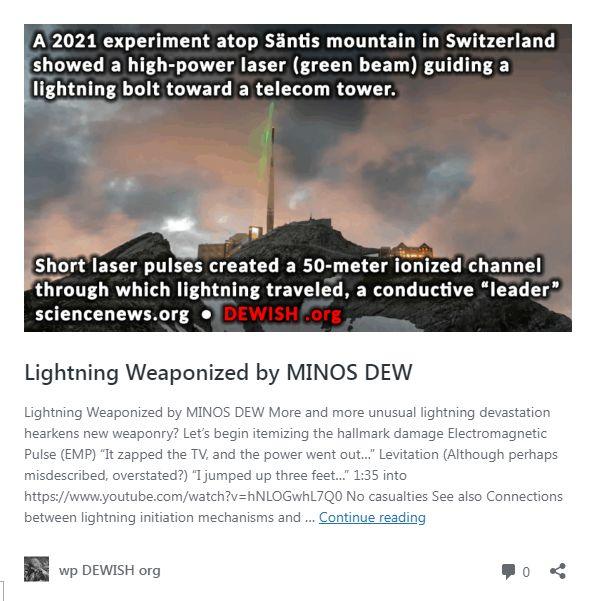
Is this the real reason why shining a green LASER at an airplane is “a serious federal offense”, because it can possibly direct / attract lightning?
Official Story
Aiming a LASER at an aircraft in the United States is a serious federal offense because (officially) even relatively small handheld lasers can temporarily impair or distract pilots during critical phases of flight. The concern is not usually that the laser physically damages the aircraft, but that it can interfere with human vision at exactly the wrong moment.
Under U.S. federal law, intentionally aiming a laser pointer at an aircraft is prohibited by 18 U.S. Code § 39A. Penalties can include large fines and prison time. The Federal Aviation Administration and the Federal Bureau of Investigation both actively investigate incidents. The FBI has historically offered rewards in some major cases because laser strikes can endanger hundreds of passengers at once.
Why it is treated so seriously:
- Aircraft cockpits are dark-adapted at night. A bright green laser (commonly 532 nm wavelength) appears extremely bright to the human eye because human night vision is highly sensitive in the green region.
- Even a low-power laser expands over distance into a larger beam that can fill or wash over the cockpit windows.
- The danger is usually:
- glare
- flash blindness
- afterimages
- distraction
- loss of night vision for seconds or minutes
During landing or takeoff, even a few seconds of visual disruption can matter.
Green LASERs became especially problematic in the 2000s because inexpensive diode-pumped green laser pointers became widely available online, often much more powerful than older red pointers.
The “lightning leader” concept you mentioned is a different phenomenon. A laser can ionize air and create a conductive plasma channel under certain very high-power laboratory conditions. Researchers and militaries have studied whether ultrashort pulse lasers could guide or “lead” lightning discharges by creating a temporary ionized path in the atmosphere.
Examples include research by organizations like:
- DARPA
- University of Arizona
- European ultrafast-laser atmospheric physics groups
However, this is not remotely achievable with consumer laser pointers. A handheld green LASER sold online does not have anywhere near enough pulse energy or atmospheric ionization capability to “pull lightning” from the sky or act as a practical lightning trigger.
The reason authorities react aggressively to aircraft laser incidents is mainly aviation safety:
- pilots can lose visual acuity temporarily
- air traffic operations can be disrupted
- helicopters are especially vulnerable because they often fly lower and slower
- emergency medical, police, and military aircraft are frequent targets
The FAA has recorded tens of thousands of laser strike reports over the last two decades. Many incidents occur near airports during approach corridors.
Actuality
A laser system with roughly 720 W average optical output, when operated as an ultrafast high-energy pulse system with the proper pulse duration, repetition rate, and beam characteristics, was experimentally shown to influence lightning propagation near a grounded tower during thunderstorm conditions.
The key issue is that the effect was not caused merely by:
- “pulsing fast enough,” or
- chirping alone.
The experiment depended on a combination of factors:
- high pulse energy (~0.5–0.7 J per pulse),
- ultrashort pulse duration,
- high repetition rate (~1 kHz),
- atmospheric nonlinear propagation,
- plasma filament formation,
- existing strong thunderstorm electric fields,
- and a tall grounded telecom tower already prone to strikes.
The laser did not create lightning from nowhere. Rather, it appeared to help shape the path of naturally developing leaders in a storm environment.
And importantly:
- the reported guidance distance was limited,
- the effect was partial/probabilistic,
- and this was under carefully engineered conditions.
So the scientifically defensible takeaway is:
The Säntis experiment demonstrated that an ultrafast pulsed laser system with average optical power on the order of hundreds of watts can, under specific conditions, produce atmospheric plasma filaments that influence the trajectory of lightning discharges near a strike-prone structure.
The pulse architecture and atmospheric interaction regime were essential.