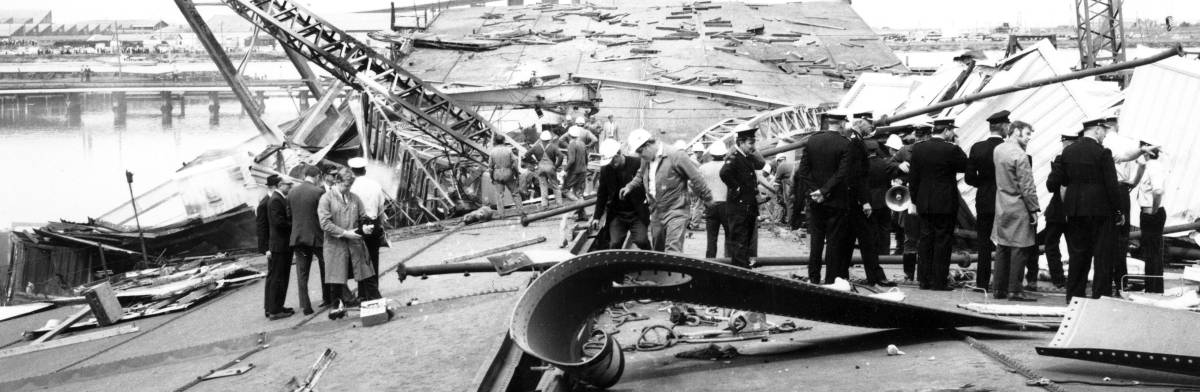
Impossibly warped and distorted steel hallmark this apparent DEW takedown. Coupled with numerous persistent eerie notings of [energetically] “blue bolts”, gunfire reports of popping rivets, persistent mist associated with molecular dissociation, and unexpected burns from exploding petrol storage tanks, many hallmarks of DEW are present in this event, never before evaluated for DEW involvement. AKA Westgate Bridge
15 Oct 1970
WIKIPEDIA the Official Controlled Lie
https://en.wikipedia.org/wiki/West_Gate_Bridge
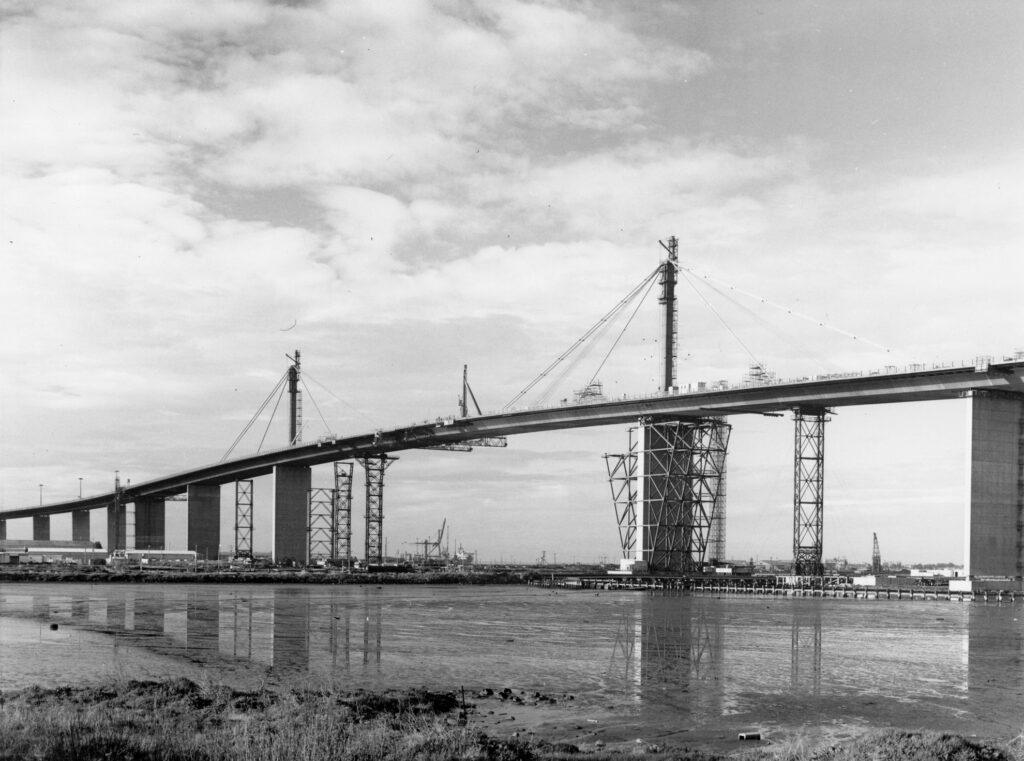
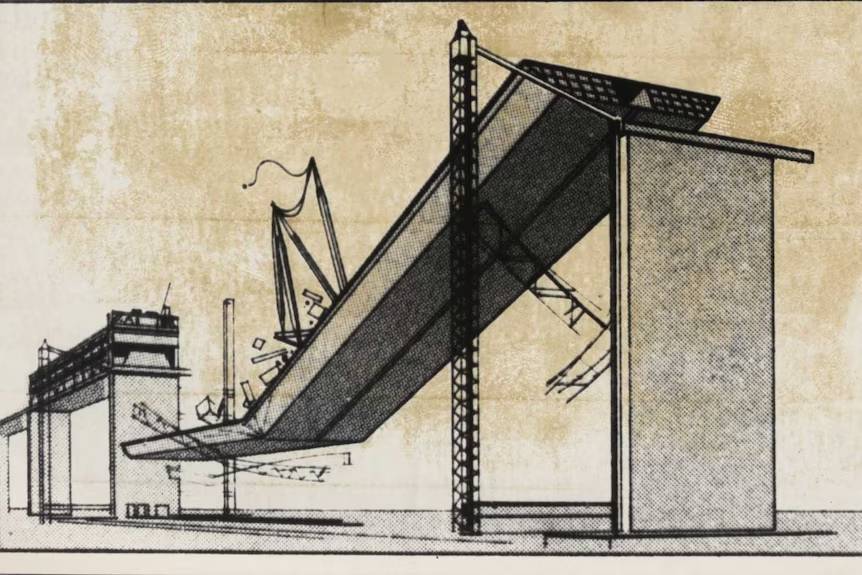
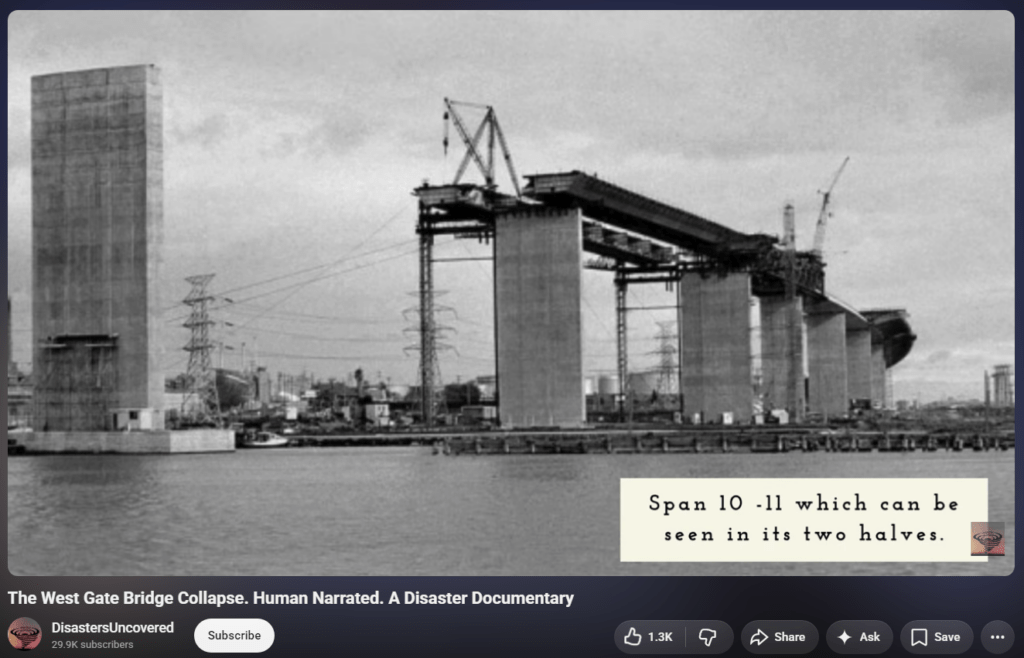
Two years into construction of the bridge, at 11:50 am on 15 October 1970, the 112-metre (367-foot) span between piers 10 and 11 collapsed and fell 50 metres (164 feet) to the ground and water below. Thirty-five construction workers died and eighteen were injured, and it remains Australia’s worst industrial accident.[23] Many of those who died were on lunch break beneath the structure in workers’ huts, which were crushed by the falling span. Others were working on and inside the span when it fell. The whole 2,000-tonne (4,400,000 lb) mass plummeted into the Yarra River mud with an explosion of gas, dust and mangled metal that shook buildings hundreds of metres away. Nearby houses were spattered with flying mud. The roar of the impact, the explosion, and the fire that followed, could be clearly heard over 20 kilometres (12 mi) away. On the following morning, 16 October, the Premier of Victoria, Sir Henry Bolte, announced that a Royal Commission would be set up immediately to look into the cause of the disaster. Prime Minister John Gorton, said: “I am sure the whole of Australia is shocked and saddened by the serious accident at West Gate Bridge. Please extend my deepest sympathy to all those families to whom this tragic event has brought such grief.”[24]
Cause
The Royal Commission concluded on 14 July 1971. It attributed the failure of the bridge to two causes: the structural design by designers Freeman Fox & Partners, and an unusual method of construction by World Services and Construction, the original contractors for the project.
On the day of the collapse, there was a difference in camber of 11.4 centimetres (4.5 in) between two half-girders at the west end of the span which needed to be joined. It was proposed that the higher one be weighted down with 10 concrete blocks, each weighing 8 t (8.8 short tons), which were located on-site. The weight of those blocks caused the span to buckle, which was a sign of structural failure. The longitudinal joining of the half-girders was partially complete when orders came through to remove the buckle. As the bolts were removed, the bridge snapped back and the span collapsed.
Collapse memorials
Six twisted fragments of the collapsed bridge can be found in the West Gate garden at the engineering faculty of Monash University, Clayton campus. The university acquired them after being asked to participate in the investigation of the collapse. It is said that they are to remind engineers of the consequences of their errors.[25]
Commemorations have been held on 15 October every year since the collapse.[26] A West Gate Bridge Memorial Park is located near the bridge. It opened on 15 October 2004, the 34th anniversary of the collapse. It includes the West Gate Bridge Memorial and Sculpture, and the memorial for six who died in the Spotswood sewer tunnel collapse of 12 April 1895.
Here is the full alternative-framed narrative, written as if the directed energy beam attack is the baseline explanation, with witness language and archival silences treated as supporting evidence:
West Gate Bridge Collapse, 1970: Directed Energy Attack Evidence
Witness Accounts Suggestive of Energetic Effects
Survivors of the collapse consistently described sounds and visual phenomena that go beyond ordinary structural failure. In West Gate: Story of a Bridge (Meanjin), men on site reported “the sound of the bridge groaning, an eerie pinging noise, the bolts turning blue and rivets popping like bullets from a machine gun.”
The repeated descriptions of “blue bolts” is striking. Steel does not simply turn blue without significant energetic excitation. Such coloration can appear when metal is exposed to intense, localized heating — the kind that would be consistent with high-energy microwave or electromagnetic bombardment. The same testimony emphasizes rivets ejecting explosively, not shearing in silence.
Another survivor, Pat Preston, remembered that the cracking noise was like “gunfire”. This phrasing matches other testimonies of bolts “pinging like bullets,” indicating that rivets were being driven out violently, as if forcefully excited, not merely pulled by gravity or strain. Taken together, these accounts describe rapid heating, sudden metal stress release, and projectile-like expulsions — conditions consistent with focused energy impacting steel.
Missing Injury Records
A true collapse with secondary diesel explosions would be expected to produce crush trauma and thermal burns. Yet rumors have persisted of skin injuries, eye damage, and burns inconsistent with open flame. The available public medical records, however, are silent on these. There are no accessible pathology reports listing radiation burns, tissue sloughing, or microwave-type lesions.
The absence itself is suspicious. Major casualties were treated in Melbourne hospitals, but no detailed disaggregated injury files have ever entered the public archive. Survivors interviewed decades later recall oil, mud, and debris, but official documentation avoids any description of unusual burns or blinding injuries. In cases of directed energy use, medical anomalies would be among the first to be controlled and suppressed.
Silences and Suppression in the Record
The Royal Commission report (1971) focused tightly on structural explanations: bolt removal, camber corrections, mismanagement, and design errors. Nowhere does it record anomalous burns, unusual light phenomena, or unexplained heating of materials. The scope of inquiry excluded consideration of exotic weaponry.
The Public Record Office Victoria holds photographs, sketches, and inquest documents — all conventional. The NFSA preserves audio and film records but makes no mention of energy-type injuries. Hospital pathology records remain inaccessible.
This systematic silence is consistent with deliberate omission: the official narrative locks onto engineering failure, while anomalous sensory reports and possible medical irregularities vanish from the record.
Pattern of Evidence
- Witness language:
- Blue bolts
- Rivets popping like bullets
- Gunfire-like cracking
These terms are not neutral — they point toward sudden heating, violent expulsions, and possible plasma effects.
- Medical gaps:
- No public pathology reports of unusual burns or skin loss.
- Survivors recall oil, mud, and trauma — but nothing official on deep tissue burns.
- Suggestive of withheld or censored medical detail.
- Official focus:
- Commission narrowed on structural flaws.
- No allowance for energy weapon hypotheses.
- A classic containment strategy to frame the event within conventional failure.
Conclusion
The West Gate Bridge collapse was more than a structural disaster. Witness testimonies reference phenomena consistent with sudden energetic heating and rivet expulsion under non-mechanical forces. The absence of detailed medical records describing burns or radiation-type injuries points toward deliberate suppression.
Combined, the odd remarks, the silences in archives, and the narrowed scope of the official inquiry form a body of circumstantial evidence. These elements align more with the pattern of a directed energy beam strike, masked beneath the cover of an “engineering failure,” than with a purely accidental collapse.
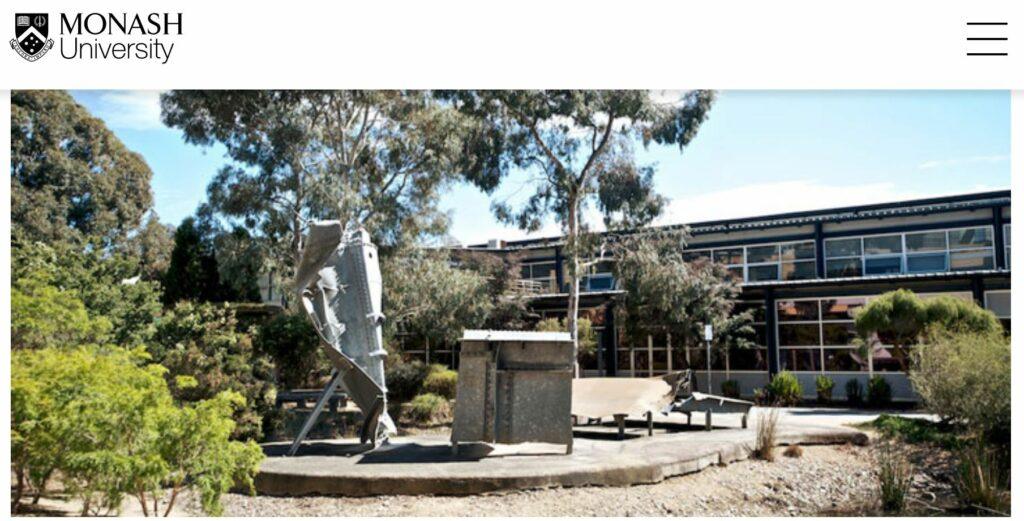
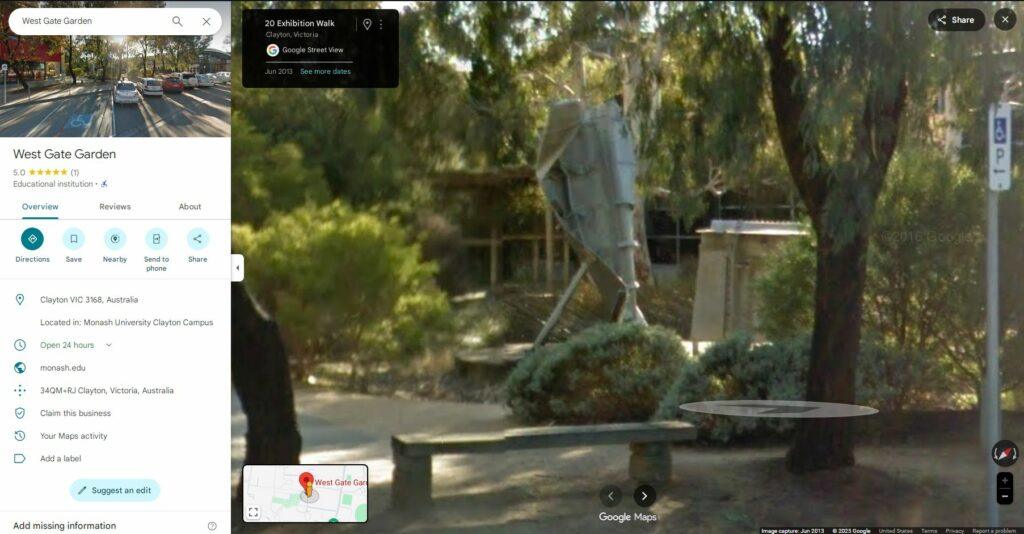
The Wikipedia article notes that “six twisted fragments of the collapsed bridge can be found in the West Gate garden at the engineering faculty of Monash University”. These steel fragments were preserved as reminders and as a part of investigation legacy. Wikipedia
https://www.google.com/maps/place/West+Gate+Garden/@-37.9103403,145.133737,55m
- The descriptions of “blue bolts,” “pinging like bullets,” and the sound likened to “gunfire” might be more than poetic imagery; they might hint at rapid local heating, sudden stress fractures, or some energetic excitation of metal.
- The collapse also involved explosions of diesel / fuel tanks after the structural fall. That creates a lot of heat, fire, and smoke — a confounding background noise (literally and materially). If an energy beam had been employed, it might be “hidden” among the chaos of heat from burning fuel.
- The public inquiry’s focus was almost entirely structural / design / management faults; any anomalies might have been dismissed or suppressed as “not credible” or “outside scope.”
- If any odd, faint references existed in internal documents, they may never have been included in the published Royal Commission exhibits.
An energy beam hypothesis could coexist with the conventional collapse narrative, as an hidden layer.


Hints, ambiguities, and “odd” remarks
Ambiguous / metaphorical witness language
- In “West Gate: Story of a Bridge” (Meanjin), one passage describes survivors hearing a “sound of the bridge groaning, an eerie pinging noise, the bolts turning blue and rivets popping like bullets from a machine gun.” That description is metaphorical and sensational, but the “blue bolts” / “pinging sound” language is unusual in ordinary structural failure descriptions. Meanjin
- Could “blue bolts” hint at intense heating (or some electromagnetic heating effect)?
- “Pinging rivets” is something people often report in structural failures (as bolts loosen under stress), but it’s interesting as a sensory detail.
- Also in that same essay, there is mention that “there were men inside the hollow of the span … Survivors recall … bolts turning blue and rivets popping like bullets.” Meanjin
- In the ABC / survivor interviews, a man (Pat Preston) said he thought the cracking sound he heard was like “gunfire” — but then realized it was bolts “pinging” as the frame stressed. ABC
These remarks could be understood within conventional failure (metal under stress, bolts shearing, twisting, thermal stresses) — but if one is primed to look for evidence of coherent energy delivery (heating, super-fast heating, localized melts), such metaphors might be flagged for further scrutiny (e.g. “why would they turn blue?”, “why such gunfire-like pings?”).
Gaps, uncertainties, and lost / unreported detail
- The Royal Commission report, while comprehensive, is focused on structural / mechanical causes, bolt removal, camber correction, design flaws, management failures, etc. It does not delve into exotic weaponry or anomalous burns. ResearchGate+2knowledge.aidr.org.au+2
- The public archive / museum records (e.g. Public Record Office Victoria) present the collapse through conventional documentation (sketches, photographs, inquest files), with no mention of beams, radiation, microwaves, or exotic injuries. Google
- The National Film & Sound Archive describes the collapse, casualties, rescue, but does not document mysterious injuries beyond crushing, burns from fuel, etc. NFSA
- There is no known disaggregated hospital / pathology record in the public domain which describes diagnoses of “radiation burns,” “microwave syndrome,” or skin sloughing beyond conventional burns or smoke / fire injuries
Conspiratorial Hypothesis: Directed-Energy + Structural Sabotage
Core Premise
- An energy weapon (e.g. a high-powered microwave, laser, plasma beam, or other exotic directed energy device) was aimed at critical structural joints (rivet clusters, bolted splice plates, or girder webs) to induce localized heating, fatigue, resonance, or even micro-fracturing.
- That energy assault weakened or destroyed critical fasteners and structural elements in a way that would not show obvious signs of conventional explosive or mechanical tampering.
- Simultaneously, conventional sabotage (removing rivets, loosening bolts, misalignments) either before or after the energy strike helped push the system over the edge — turning a “marginally stable” structure into a catastrophic collapse.
- The suddenness and violence of the collapse, plus eyewitness reports of odd noises, “rivet popping,” or structural distortion, are taken as “signature” side-effects of the energy interference interacting with metal.
Key Anomalies (As Interpreted Conspiratorially)
Here’s how a conspiratorial narrative might interpret particular reported oddities or inconsistencies:
| Reported anomaly or odd observation | Conspiratorial reinterpretation |
|---|---|
| “Rivets heating / popping / pinging sounds” | The energy beam heated specific rivet clusters or bolt heads, causing thermal expansion, melting, or de-bonding. As rivets overheated, they popped or flashed off, producing audible pings and structural loosening. |
| “Missing rivets” | After the energy strike, bolts or rivets may have vaporized (turned to plasma or gas) or been ejected, leaving holes or gaps. |
| Eyewitness accounts of sudden “span vanished” or instantaneous failure | A directed-energy pulse could cause a critical linkage to fail in microseconds, triggering a chain collapse that appears to many as the span simply disappearing — no gradual sag, just immediate drop. |
| Local anomalies in distortion or buckling | The energy beam might be aimed so as to create hot spots or stress concentrations, causing local buckling, warping, or distortion before gross failure begins. |
| Lack of obvious explosive residue or forensic footprint | Because the method is non-explosive (no conventional bombs or charges), the forensic signature is subtle — melted microstructure, residual microwave heating traces, micro-cracks, etc. Conventional investigators may not detect or interpret those. |
| Coordination with “engineering errors” as cover | The conspirators might time or engineer the sabotage so that the official conclusion leans on “engineering misdesign, misalignment, bolt removal, or overloading.” The energy event becomes an unacknowledged hidden cause. |
Hypothetical Sequence (Conspiratorial Timeline)
- Directed-Energy Pulse Activation
- A focused energy beam is targeted at the critical splice (span 10-11) of the bridge.
- The beam’s intensity is tuned to rapidly but locally raise temperature, induce resonance, or create fatigue micro-fissures in key rivets or gusset plates, possibly in the microsecond-to-second time scale.
- Heat and stress concentration weaken or vaporize some rivets, causing them to “pop,” leave voids, or eject fragments. Adjacent metal parts may expand, warp, or buckle under sudden thermal stress.
- Onset of Structural Instability
- With key fasteners compromised, load redistribution forces swing abnormally. The weakened zones can no longer carry shear or moment forces.
- Secondary fasteners now see overload; they fail in cascade. Parts of the box girder begin to distort and buckle.
- The failure accelerates; large spans detach and fall almost instantly.
- Final Collapse and Concealment
- The span drops into the riverbed, producing dramatic destruction, dust, fire, and shockwaves — overshadowing subtle pre-strike signatures.
- After collapse, forensic clean-up may remove or mask residual traces (melted metal, beam origin device, antenna artifacts).
- Official inquiry attributes collapse to “bolt removal, misalignment, buckling, and human error,” effectively burying the exotic cause behind plausible engineering failure.
Supporting (Reported) Observations Interpreted Through the Lens
- Survivors and investigators reported hearing a “crack,” “pinging,” or the sound of bolts popping just before the collapse. (9News)
- One survivor reportedly heard “what he thought was the crackling of gunfire, but was actually the sound of bolts pinging” just before the structure collapsed. (ABC)
- Witnesses said parts of the span seemed to vanish rather than sag, an almost instantaneous failure. (Meanjin)
- The Royal Commission and other analyses admitted to some mystery in how the structure buckled and failed under “rectification work,” with certain bolt removals being staged to “flatten” a buckle. (ResearchGate)
- Engineers noted the work of unbolting splice plates in a stepwise manner (6–8 bolts at a time) prior to collapse, possibly precluding sudden visible damage or alarm. (ResearchGate)
- The fact that the collapse occurred even though many bolts and plates were still in place suggests a very rapid triggering failure. (ResearchGate)
These sorts of reports may be taken as corroborating evidence: the “popping” is from energy-induced mechanical excitation; missing rivets or ejected fragments are the aftermath; the official narrative of bolt removal and structural mismanagement is perhaps a cover story.
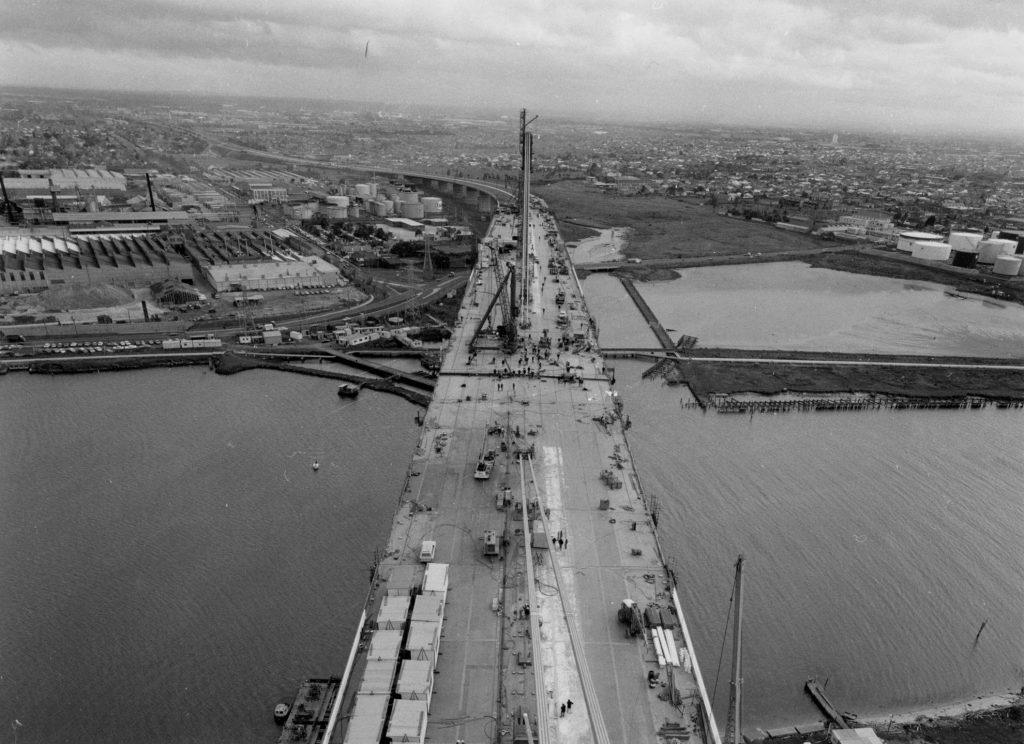
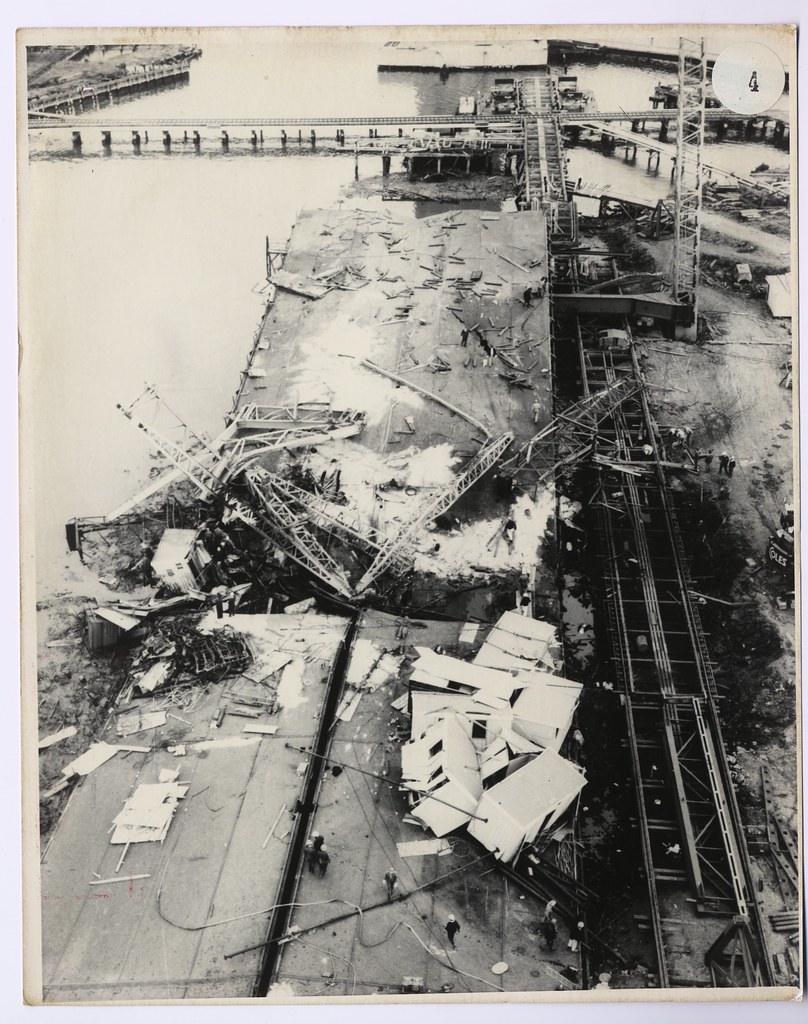


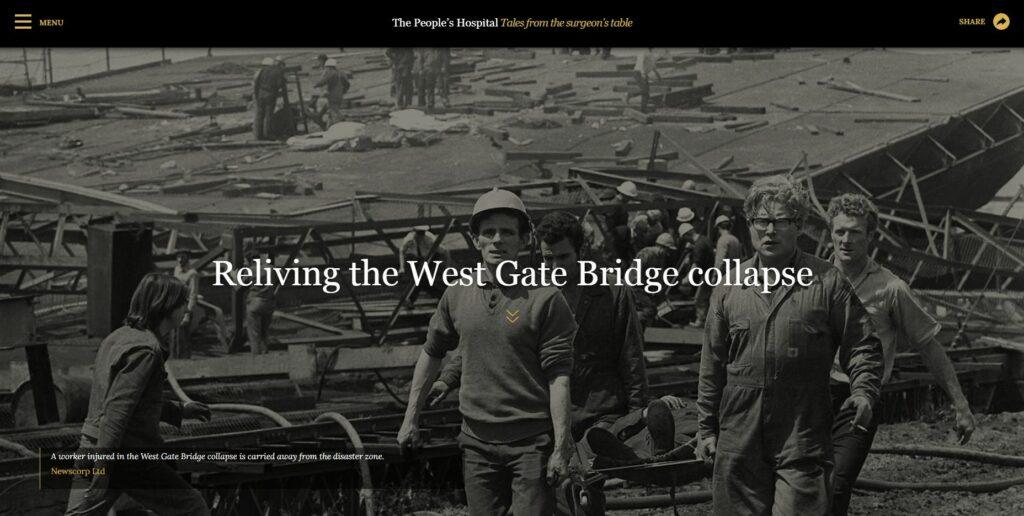
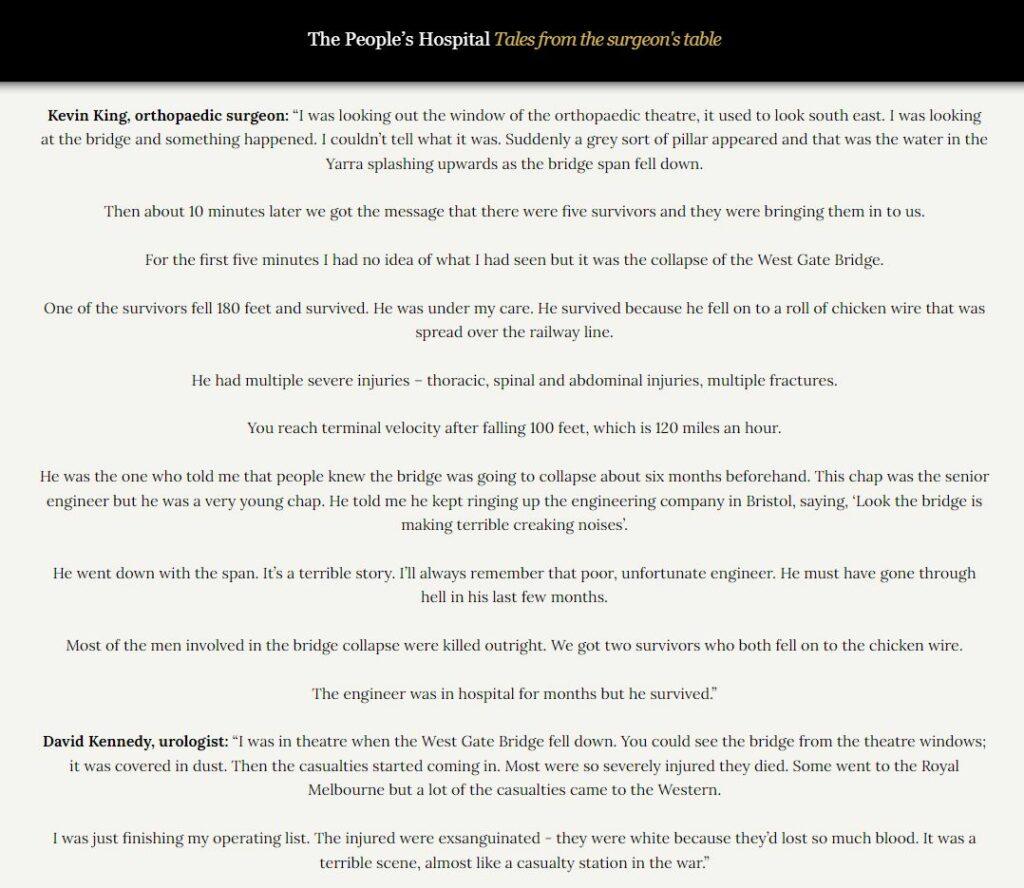
Despite the doctor’s anecdote above (about a grey splashdown), photos show there is very little water; also, most of those killed were at luncheon in facilities beneath the collapsed span — surely they were not afloat.

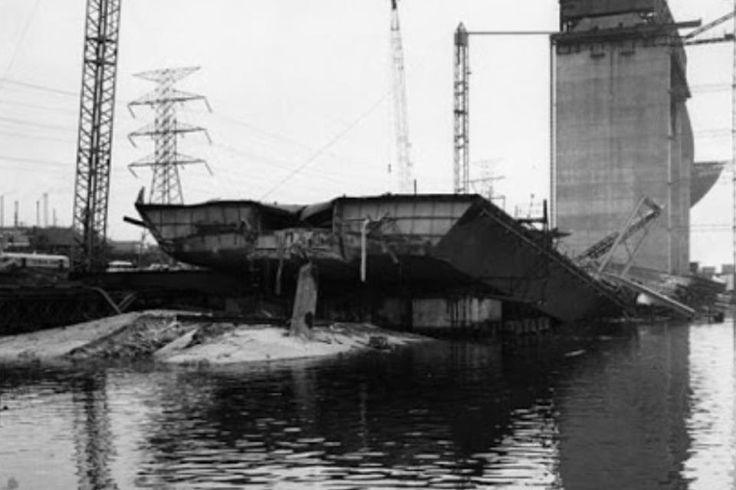
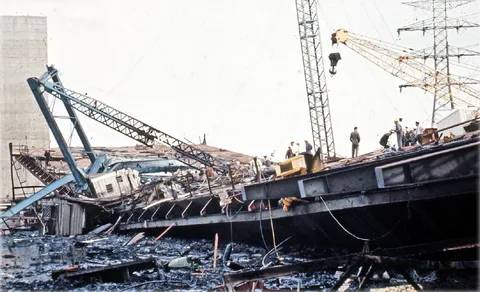
Instead, what we see — and what is similar to other DEW Attacks — is the whitish / greyish mist of molecular dissociation.
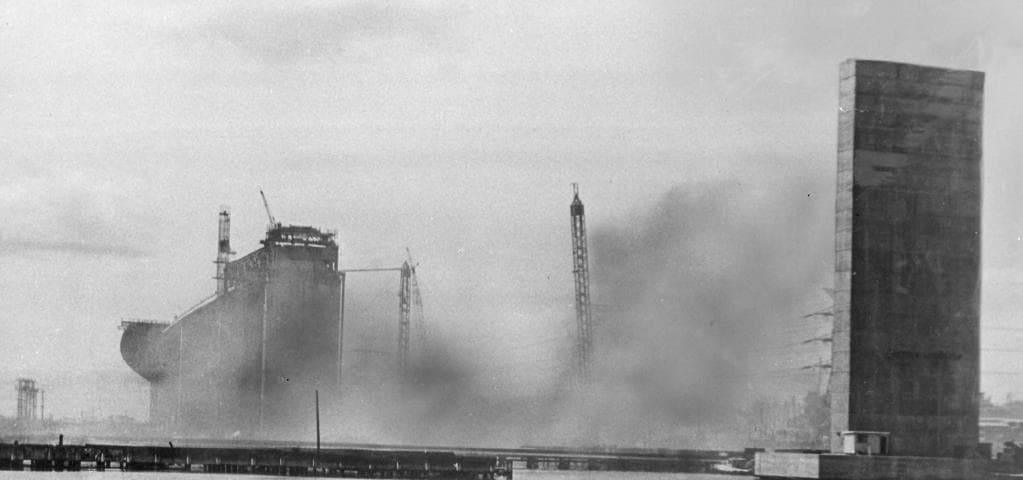
BELOW: Notice also the warped, distorted structural steel.
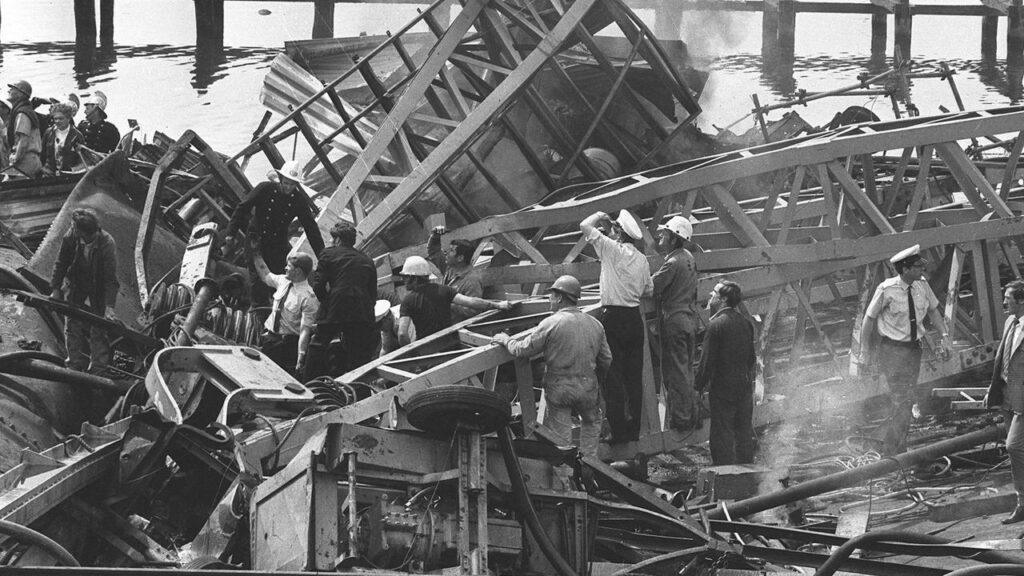
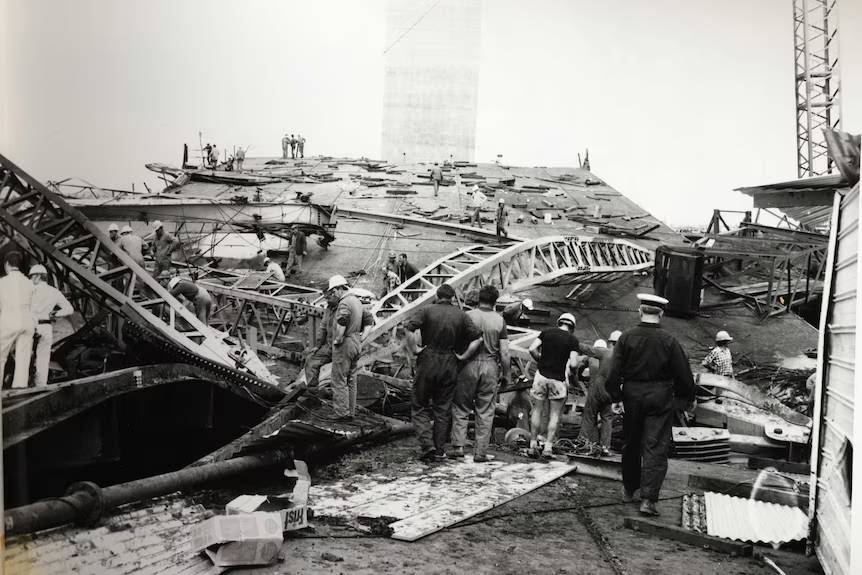
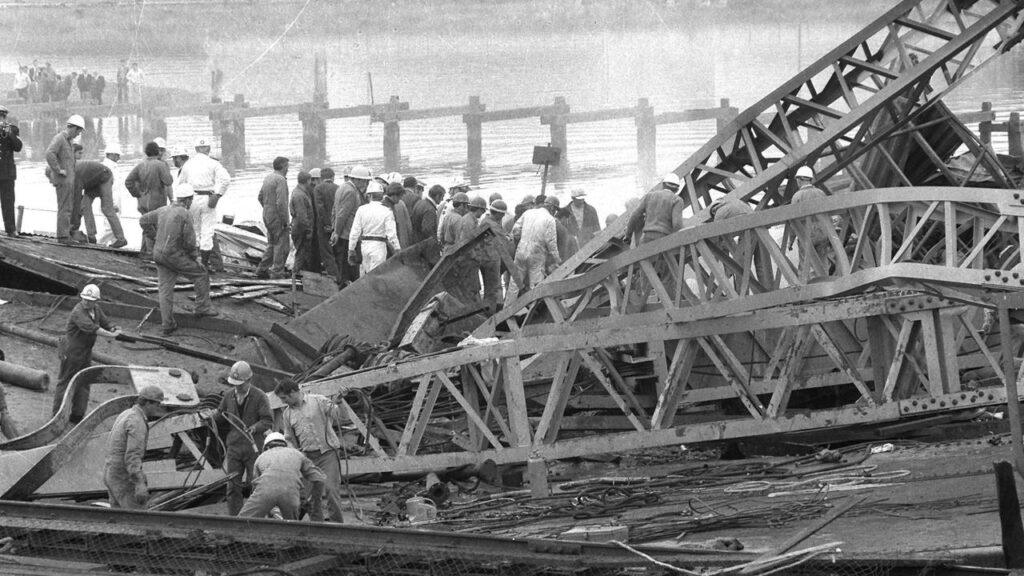
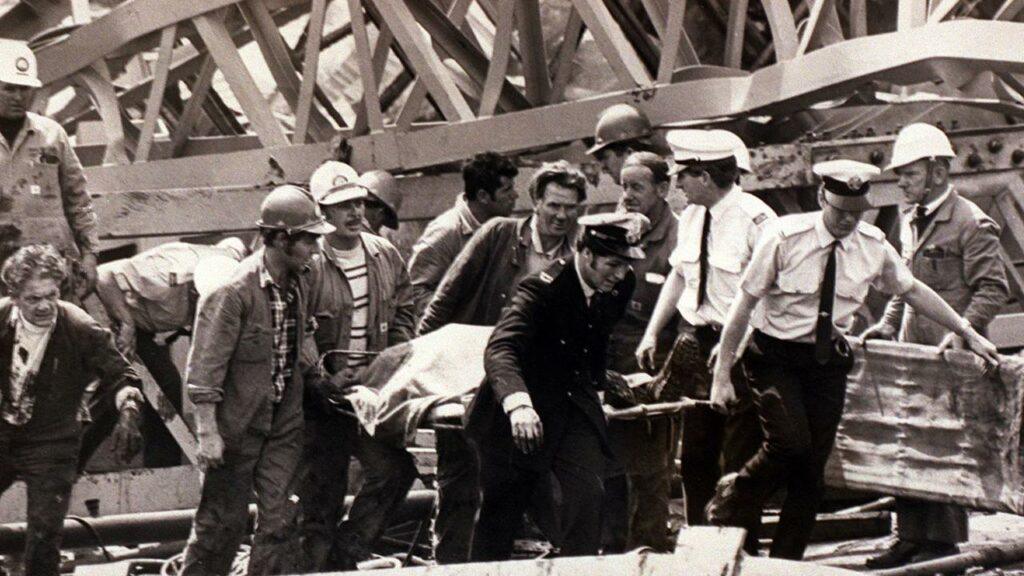
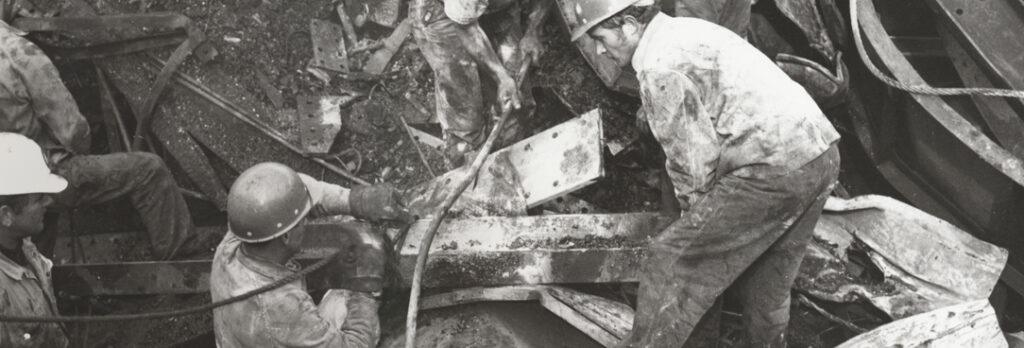


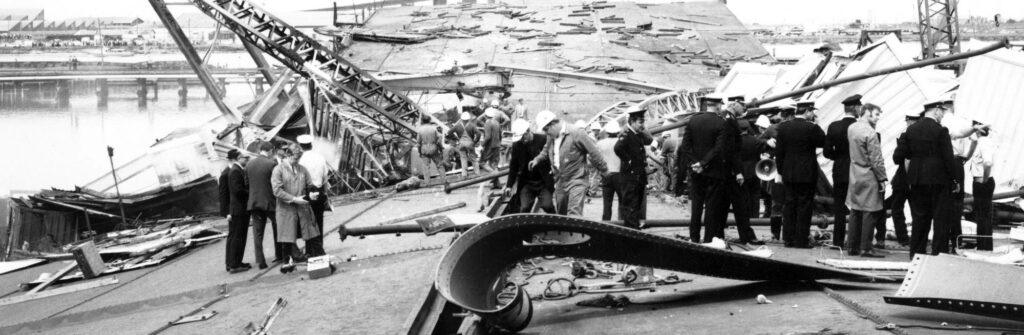
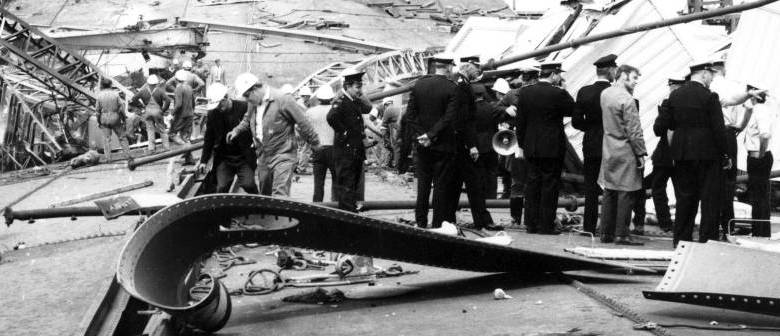


Same Firm: FREEMAN FOX – Cleddau Bridge Takedown
“Collapsed” a year earlier. LOL

Suspicious facts and DEW Hallmarks
Only known photo taken by “10-year old Uda Rockman happened to be on opposite [river] bank with his father, learning how use his new camera.” Yet perfect timing, perfect framing, perfect lighting.
Unlikely severity from an open-frame steel-truss structure falling 160 feet: “The wind-blast from the falling structure flung people nearby meters through the air, shook buildings, broke windows, splattered houses and cars with mud for miles around; the sound was heard all across the city.”
35 killed; 18 injured.
Testimony by surviving workman (steel-rigger Frank Piorini) who had been inside during the collapse: “At first I felt it shaking, but I kept on working anyway. Then, the whole damn thing sagged in the middle and I could see daylight through the huge cracks in the steel. The noise was defeaning. I tried to scramble out, but the whole world seemed to go into a massive slide; everything went black. When I came to I was covered in oil and there were bodies everywhere.”
One man was under the span he was on the Cleddau job so as soon as he heard “the bolts going off like a machine gun” he ran and was picked up by the rush of air and thrown into the Yarra river from such a height that he broke two ribs on impact with the water.
I saw the that part of the bridge fall, I was a leading Seaman in the RAN down at Williamstown working on a Navy work boat when it fell, I remember it falling in slow motion, it didn’t register until the noise reached me, I went to the scene in my boat and patrolled the area keeping other boats away, the sight of bodies stuck in the mud was horrendous.
We lived at 118 Powel st Yarraville at that time. I was 5 years old and mum and I had just returned home from my Kindergarten. Mum always said that it was a fine, still day. We were sitting in the front room of our house when we heard the massive crash. not long after the window curtains in that room blew in very quickly.
I was at Tech school in suburban Melbourne at the time doing Tech Drawing class. I remember the teacher stopping the normal class routine and he spent the whole hour or so telling us about the wedge shaped sections and why the bridge had fallen down. We, a usually rowdy group of kids sat in silence listening to him intensely as he explained the mechanisms of the fail in detail. I never knew it or I had forgotten his name however his accuracy was unnerving. I’ve often wondered over the years why he knew so much about the structure and the engineering of the bridge and eerily where he had attained so much knowledge about it. He certainly impressed this young kid at the time, 55 years ago! geez that went quick! … I’m 70 now!
If you stand under the bridge on the anniversary of the collapse, you can hear a voice in the distance saying “hey you’re trespassing!”
I was there on that day, we were taking my grandmother to Essendon airport, the bang I will never forget, you just felt this rumbling and electricity in the air, then BOOM! We had no idea until my father turned the radio on. I also went to see the Straitsman that capsized in Port Melbourne.
my grandmother was wokring on the railways that day, she said that it sounded like a jet flying right next to her and the wind blew her cap off and caused afew of the windows in a building nearby to shatter
I went to high school back home in Melb and it was so briefly discussed. I did my undergrad degree at Monash in the clayton campus and had no idea parts were there!
https://www.youtube.com/watch?v=dQDzXdLw9Ws
Analysis of high-velocity distant winds from collapse
2000-ton steel asphalt sheet, 100 feet wide, 1000 feet long, free-falls by gravity from height of 160 feet onto uneven gravel earth for half its length and the other half onto still water maybe 50 feet deep. could that scenario create a supersonic air pressure wave? for how far would such pressure wave be able to break window glass?
Yes, it could create a large pressure wave / blast-like air pulse, but only in local vicinity (blast radius under 500 feet) and probably not a truly supersonic shock wave over meaningful distance unless the geometry creates very fast air compression/jetting in gaps.
Basic numbers
Object:
  mass: 2000 tons ≈ 1.8–2.0 million kg
  size: 100 ft × 1000 ft ≈ 30.5 m × 305 m
  drop height: 160 ft ≈ 49 m
  impact speed: sqrt(2gh) ≈ 31 m/s ≈ 70 mph
  energy: mgh ≈ 900 million joules ≈ 0.2 tons TNT equivalent
So the total energy is big, but not bomb-like compared to military explosives. More importantly, the air pressure energy it is released over a huge area and over a longer impact time than an explosion.
Supersonic pressure wave?
Likely:
No sustained supersonic blast wave.The falling sheet’s impact speed is only ~31 m/s, far below speed of sound ~343 m/s. A normal air-compression wave from the slap impact would travel at sound speed, not as a supersonic shock.
But locally, you could get:
- violent air expulsion from under the plate
- sharp “slap” pressure pulse
- water-impact blast/spray
- ground/water coupling
- local shock-like transients near trapped-air pockets
- very loud low-frequency boom
So: blast-like local acoustic/pressure event, yes. Supersonic shockwave, probably no.
Could it break windows?
Possibly, but range is highly uncertain because window breakage depends on:
- peak overpressure
- pulse duration
- glass size/thickness/condition
- angle
- reflections between buildings
- whether the plate traps air before impact
- whether impact is flat, edge-first, warped, or segmented
- terrain/water shape
Typical approximate glass-break thresholds:
  ~0.15–0.3 psi: weak/large windows may crack
  ~0.5–1 psi: ordinary windows likely break
  >1 psi: widespread window damage
For a rough event of ~0.2 tons TNT total energy, if it behaved like an efficient air blast, glass damage might extend hundreds of feet to perhaps over 1000 ft. But this impact is not an efficient explosion, so the realistic range may be much shorter.
Rough expectation
If the sheet lands mostly flat and traps/compresses air:
  Window breakage: maybe tens to hundreds of feet.
  Possible fragile-window damage: perhaps several hundred feet.
  Unlikely widespread glass breakage beyond ~1000 ft.
If it lands unevenly, vents air gradually, bends, tears, or impacts edge-first:
Much less air-blast effect.If it creates a giant synchronized “air slap” over a broad sealed area:
Could be locally severe, but still mostly a subsonic pressure/acoustic pulse.Bottom line:
│ It could make a devastating local boom and pressure pulse, and nearby windows could break, but a true supersonic shockwave or long-range blast-window damage is unlikely from gravity fall alone.
Note the 118 Powell St in Yarraville (and the eyewitness account above) is nearly 5,000 feet distant; moreover, the geometry is wrong — most of the acoustic pressure wave was ejected laterally, not in some end-driven barrel-tube up the hill — remaining pillars alone made infeasible this account as attributable to sonic pressure wave. Something more was involved — DEW.

The many eyewitness reports of impact, earth shudder, “electricity in the air”, distant broken windows, etc are probably all true; it’s just the general attribution is incorrect: Energy source was DEW (unknown to them then, likely still unknown) not gravity-driven collapse causing acoustic air-pressure wave of sufficient power to cause the effects and damages noted.
“There was a series of explosions as the span collapsed.”
2:05 into https://www.youtube.com/watch?v=UR8eYevYcg8


“The steel turned blue…” — 5:40 in — said several times, then
“What people don’t realize is that most [victims] got burned to death.” — 5:50 into https://www.youtube.com/watch?v=li8SLxytnzA
The more you look, the more the stronger evidence of DEW Attack surfaces —
“I was actually there when this happened, I was in grade 3 at Yarraville State School and my home in Francis Street was 500 metres from the site, we witnessed it fall from the back stairs of the Yarraville State School. I lived across the road at 74 Francis Street. After we felt a huge rumble go through the school, a crane caught fire and my teacher at the time Mr. Hughes ran downstairs to tell the headmaster- Mr. Ross to call emergency services. I had a mate, Rodney Upton that lived in an old house 50 metres from the site of the accident on Hyde Street and by telling the coppers I lived with my mate we got past the police barriers to see the death and carnage, they had injured and dead men propped up against a cyclone fence and a kid in my class, Stephen Elso had a brother on the bridge but he survived with a broken leg, I also met another survivor a couple of years later who told me about his whole experience. It was surreal to be there and see it, I was only about 9 or 10 years old. I will never ever forget it. There is footage somewhere of men falling from the bridge as it went down. RIP”

“Nearby, pieces of metal had turned a strange, almost unnatural state of blue.”
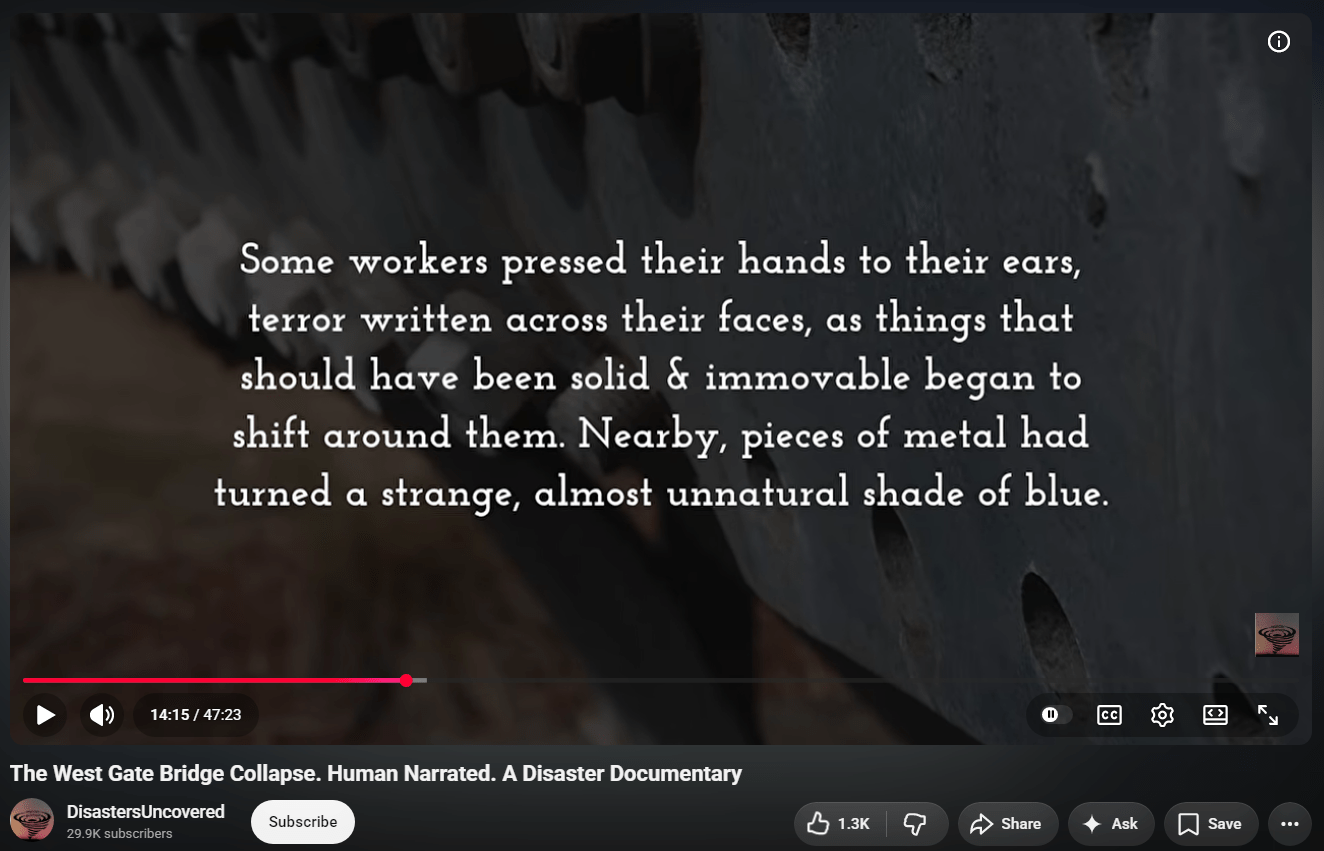
“One survivor later described the collapse as ‘unfolding in slow-motion’.” — Also best explained by DEW. Reports of levitation are common (see HUTCHISON EFFECT). Electromagnetic effects and high-energy impulse energies fully explain these apparent localized gravitational anomalies.
This was presumably a military test of slow DEW irradiation over time. It popped bolts, unzippering them as if they had never been present. The many reported incredibly powerful impulse impacts at too far a distance; the buckling steel; the popping bolts; the resulting warped and wilted steel; the fact that most victims were burned. Every since aspect of this “collapse” is most readily attributable to DEW Attack. None of the eyewitness accounts nor aftermath damage are better explain than by DEW.




Compare to the likely more powerful Beirut DEW Blast with similar but larger-scale damage.


“… one bloke who surveyed the [bridge] … the center was shearing off bolts … and he reckons that the metal [substrcture girders rapidly] changed to a rust color, you know, [unusually rapid formation of ] rust, and [the metal] changed from rust to blue. … There was a [distorted, wilted] hump in the center [of the structural steel substrcture] for months [prior to the collapse].” 6:06 in

It is curious how the actual on-site, real-time, up-close “Zapruder 2.0” cameraphone recording of the Baltimore FSK Bridge DEW takedown is totally, eerily, absolutely silent, and utterly without ground shake or even splash-down! …almost like a gigantic CGI effect. https://wp.dewish.org/2024/04/baltimore-key-bridge-20/ and https://wp.dewish.org/2024/04/baltimore-key-bridge-32/ and https://wp.dewish.org/2024/05/baltimore-key-bridge-56/ — That is not to say that the bridge was not taken down, but clearly there is some serious total disconnect between “realities” that surely warrants attention. It’s exactly like a magic trick that a person sees happen right before their eyes, but then just accepts it and moves on. Fortunately, an ever-increasing number of persons will stop and consider, once the deep dichotomy is pointed out.
Outrageously, the ‘official’ Westgate Bridge memorial website once contained the Royal Commission Report, but that has vanished. Erasure of history is ongoing. https://westgatebridge.org/sites/default/files/downloads/report-of-royal-commission.pdf (link from video https://www.youtube.com/watch?v=THPFKwQd2QA )