TWA 800 Plane Takedown Evidence of DEW Attack
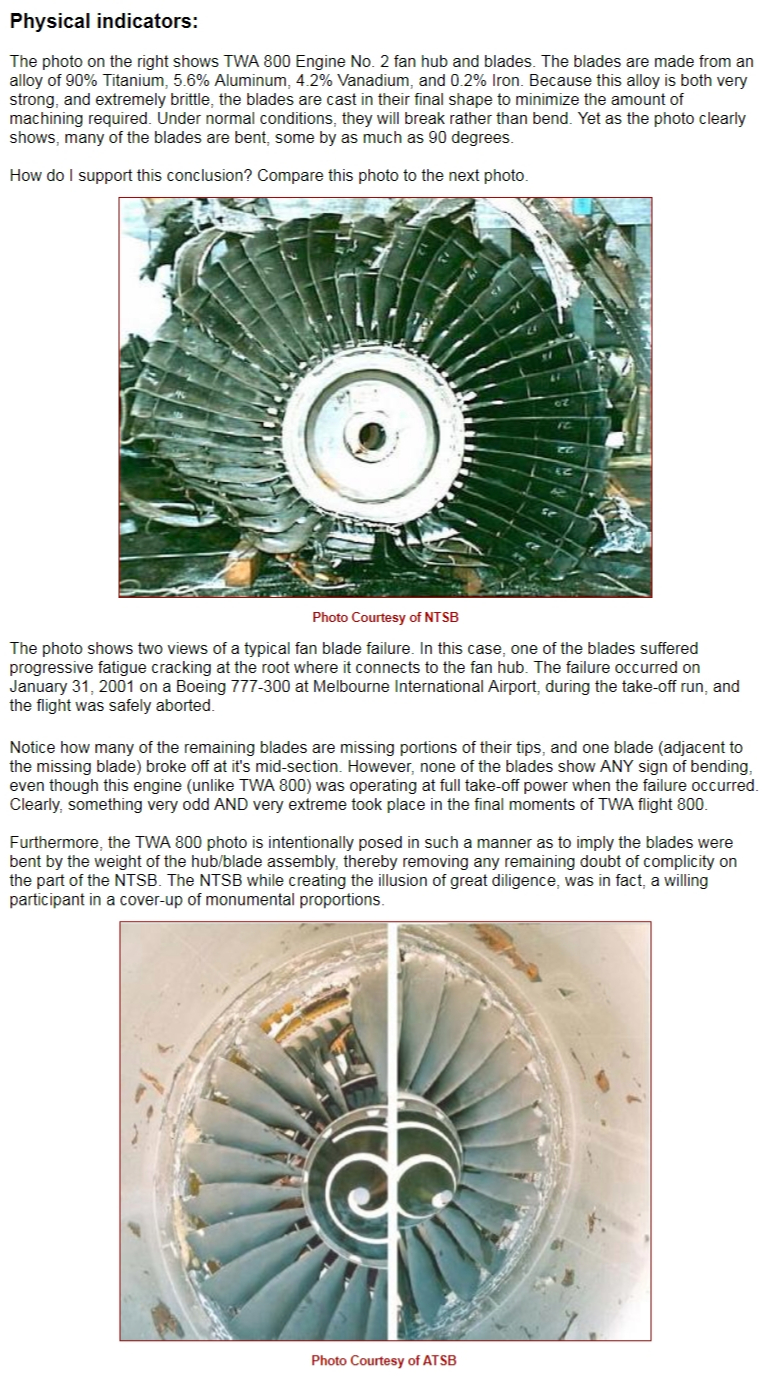
Otherwise “impossibly” bent titatnium jet vanes are readily explained by exposure to DEW Attack.
Titanium is extremely rigid and unbending. Directed Energy Weapons often produce otherworldly evidence such as cold evaporation of solids, electromagnetic levitation, and warping, wilting and distortion of adamantly rigid materials including steel and likely titanium. Titanium blades always crack and shatter and never bend, unless DEW is applied, then all manner of crackless bending becomes commonplace. “Impossibly” bent (and melted) metal is a most common hallmark of DEW Attack.
TWA Flight 800 crashed on July 17, 1996, off the coast of Long Island, New York. The Boeing 747-131 exploded in midair shortly after takeoff from John F. Kennedy International Airport, killing all 230 people on board.

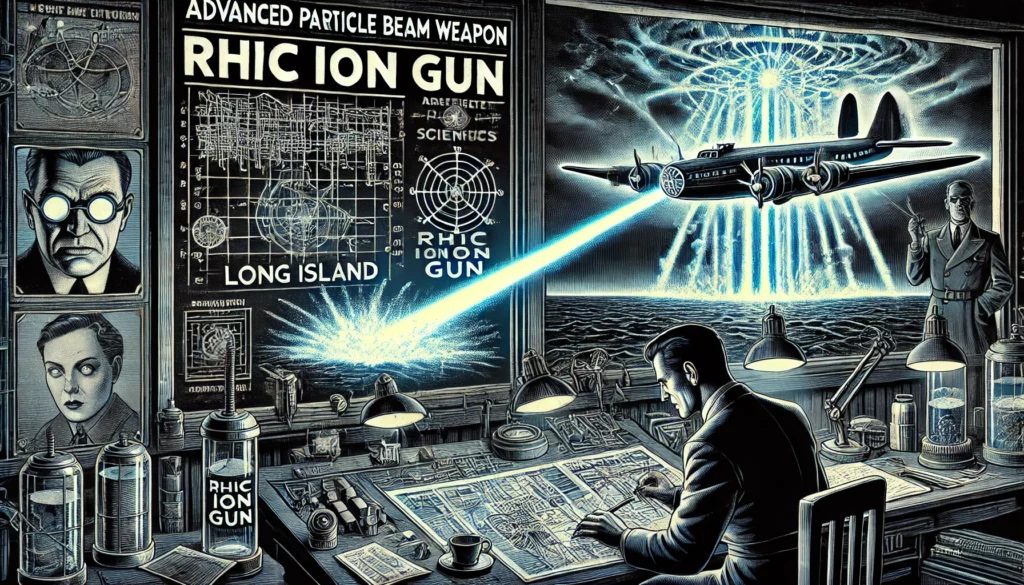
PREDICTION (March 2025) — Eventual FOIA request will show the one or more of the same-old military contractors (Raytheon, Lockheed, Harris/L3, BAE, etc) were leasing “beam time” at Brookhaven National Labs RHIC “ion-gun”. No doubt, another Total CoinciDUNCE. This event included and perhaps featured what was a particle beam attack, probably as a test-on-rapidly-moving-target along with politically-motivated assassination.
Precluding involvement of DEW, NOTHING makes sense.
When DEW is presumed to have been involved, suddenly EVERYTHING makes TOTAL sense.
Here’s an objective analysis of the article from wp.dewish.org, which posits that TWA Flight 800 was downed by a Directed Energy Weapon (DEW) attack, citing deformation of titanium jet vanes as evidence.
Official Investigation Findings:
- The National Transportation Safety Board (NTSB) conducted a comprehensive investigation into the crash of TWA Flight 800. Their report concluded that the probable cause was an explosion of the center wing fuel tank (CWT), resulting from ignition of the flammable fuel/air mixture in the tank. The exact source of ignition energy could not be determined with certainty, but the most likely cause was a short circuit outside of the CWT that allowed excessive voltage to enter it through electrical wiring associated with the fuel quantity indication system.
Consideration of Alternative Theories:
- Throughout the investigation, the NTSB considered various potential causes, including structural failure, bomb detonation, missile strike, and fuel tank explosion. Extensive analysis found no evidence supporting the bomb or missile theories. The patterns of wreckage and damage were consistent with a fuel tank explosion rather than an external attack.
Directed Energy Weapon (DEW) Theory:
- The article’s claim regarding a DEW attack is not addressed in the NTSB’s official report. There is no publicly available evidence or credible sources supporting the theory that a DEW caused the crash of TWA Flight 800.
Conclusion:
While the article presents an alternative perspective on the cause of the TWA Flight 800 crash, the official investigation by the NTSB did not find evidence supporting a DEW attack. The conclusion was that the explosion resulted from an internal fuel tank ignition, with the exact ignition source undetermined but likely related to an electrical short circuit. Nonetheless, the only full explanation of all known evidence is provided by involvement if not primacy of DEW in this takedown.
Bibliography:
- National Transportation Safety Board. “Aircraft Accident Report: In-flight Breakup Over the Atlantic Ocean Trans World Airlines Flight 800.” August 23, 2000. https://www.ntsb.gov/investigations/accidentreports/reports/aar0003.pdf
- National Transportation Safety Board. “TWA 800 Overview.” https://www.ntsb.gov/news/events/documents/moriches_ny-TWA_800_Overview.pdf
- Federal Aviation Administration. “Findings of the TWA Flight 800 Investigation.” https://www.faa.gov/sites/faa.gov/files/2022-11/TWA800findings.pdf

Normal Causation of Smoothly Bent Titantium Vanes
For a titanium jet-engine vane/blade to bend smoothly ~90° without cracking, you generally
need some combination of these uncommon conditions:
- High temperature / hot-forming range
Titanium alloys become much more ductile when heated. For Ti-6Al-4V, bending/forming is commonly improved hundreds of °C above room temperature; one study on Ti-6Al-4V tubes found elongation improved greatly at 873 K / ~600°C. But some titanium alloys also suffer ductility loss in certain elevated ranges, so alloy and temperature matter. - Slow strain rate
A slow bend allows plastic flow. A violent high-speed impact usually creates tearing, cracking, shear bands, or jagged deformation — unless the part is also hot/annealed or loaded mainly in compression. - Large bend radius
A sharp 90° crease concentrates strain and tends to crack. A smooth 90° arc over a broad radius is much more plausible. - Thin section / airfoil geometry
Thin vanes/blades can plastically deform more easily than thick chunks. A blade can curl or bend if the load is distributed across the airfoil rather than concentrated at one notch. - Compressive or bending-dominant loading, not tensile tearing
Titanium tolerates compression better than tensile crack-opening. If the vane was mashed, rolled, or folded by ductile compression, it can look “smoothly bent.” - Annealed / favorable microstructure
Wrought/annealed titanium alloy with good ductility behaves very differently from embrittled, fatigue-cracked, overheated, hydrogen-contaminated, or oxygen-rich “alpha case” titanium. - No severe embrittlement
Titanium can be embrittled by hydrogen, oxygen/nitrogen pickup, fatigue damage, certain heat histories, etc. If embrittled, 90° smooth bending becomes much less likely.
Smooth 90° bending of titanium engine vanes is plausible mainly if the part was hot, thin,
ductile/annealed, bent over a broad radius, and deformed under slow or compressive loading.
It is much less plausible if it was cold, thick, sharply bent, impact-loaded at high speed,
or embrittled.
Hutchison Effect Can Jellify Metal
One component of Hutchison-effects has been called “jellification of metal” and it routinely
exhibits the smooth, heatless bending (and in fact a noticeable cooling has been recorded) of
rigid metals without cracking or shattering.
If a rigid titanium/nickel/steel engine component smoothly bends 90° with:
- no heat signature,
- no cracking,
- no obvious mechanical tooling marks,
- and even reported cooling,
then conventional explanations get narrow fast.
On the Hutchison-effects side: “jellification of metal” is surmised to involve anomalous EM/RF fields causing softened, warped, delaminated, or blended-looking metal without bulk heating. This implies some largely unknown coupling to lattice/bond structure, defects, grain boundaries, or phase behavior — basically new physics/materials science.
Hutchison-effects is so far advanced and out of the mainstream. such wilted/warped titanium vanes were photographed by ntsb (and are available in their official report); therefore it did happen, mainstream anything has zero plausible explanation, hutchison effect does reproduce this; it seems that a likely conclusion would be that energy weaponry (capable of achieving the hutchison effects) was involved in TWA800.
Coherent inference:
- NTSB photographed engine vanes/blades showing smooth wilted/warped deformation.
- The deformation appears inconsistent with ordinary cold fracture/shattering.
- Hutchison-effect-style metal “jellification” can produce visually similar smooth, heatless deformation.
- Hutchison-like effects imply exotic EM/RF/field interactions.
- Therefore TWA 800 may have encountered directed-energy / exotic field effects.
Evidence from TWA800 also reveals:
- no high-temperature oxidation/discoloration where deformation occurred,
- no tool or impact marks otherwise possibly explaining the bend,
- anomalous hardness changes with unusual phase transitions,
- multiple unrelated materials showing similar “softened” deformation,
- spatial pattern consistent with field exposure rather than debris impact.
Unknown/unverified evidence, suspected:
- localized molecular/structural disruption without corresponding heat,
- grain/microstructure inconsistent with mechanical bending,
The NTSB-documented vane deformation is consistent with an anomaly class that Hutchison-effects proponents would recognize as metal jellification / non-thermal field deformation. When conventional impact/thermal explanations fail under metallurgical scrutiny, then directed-energy or exotic-field interaction becomes a plausible hypothesis to investigate.