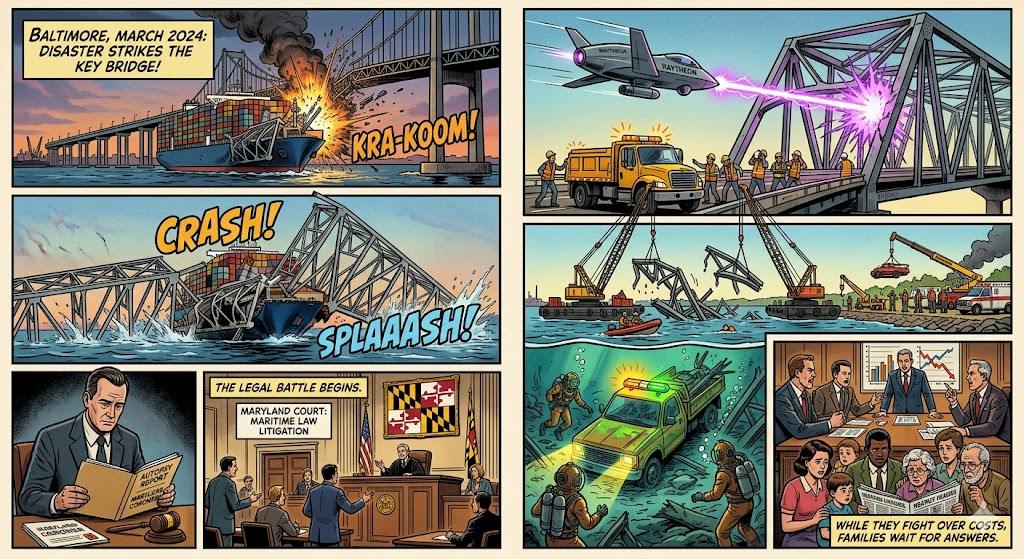
Baltimore Key Bridge Series Summary / “Cliff Notes” Brief
One-sentence overview
Across 160+ installments, the series argues that the March 2024 Francis Scott Key Bridge disaster was not a simple cargo-ship collision, but a planned bridge takedown involving directed-energy weapons (DEWs), narrative management, rapid evidence removal, and economic/political motives tied to a larger Baltimore mega-port agenda.
The central thesis
The series’ core claim is that the official story leaves far too many physical, procedural, media, and institutional anomalies unexplained, when even one inexplicable anomaly is sufficient to invalidate the official theory / exaplanation. The series repeatedly frames the DALI collision as a cover-story for a pre-planned demolition or “takedown,” with DEWs offered as the mechanism that fully explains melted, warped, missing, dustified, or strangely damaged steel; anomalous video flashes and fireballs; the speed of cleanup; missing or sealed human testimony; and the immediate push toward a taller/wider replacement bridge.
Main evidence categories presented
1. Visual/physical anomalies
The early installments focus on highlighted fireballs, white-hot bursts, orange-hot steel, molten-looking girders, warped/wilted truss members, missing bolts, missing steel, unusual gusset plates, crumpled containers, gouged hull sections, and damaged bridge pillars. The author argues these features do not match ordinary mechanical collapse, impact damage, or cold steel failure, and instead resemble the aftermath of intense directed-energy heating.
2. Collapse mechanics and bridge-design objections
A recurring theme is that the bridge should not have failed globally from one ship impact in the way shown. The series disputes “fracture critical” explanations, argues that cantilever design and original construction photos show the bridge held itself up differently than reported, and claims complete collapse would have required multiple strike or failure points. Later posts compare the Key Bridge to other truss/cantilever bridges and to cargo-ship impacts where steel allegedly cracked or snapped rather than melted or wilted.
3. DALI behavior and crew opacity
Many parts question DALI’s departure, power-loss narrative, anchor timing, previous incidents, ownership, cargo, military connections, and later movement toward Norfolk/Newport News. The author emphasizes that the captain, pilots, crew, and depositions were not publicly accessible in the way the author expected, interpreting anonymity, sealing, and departure timing as signs of a controlled or remote-operated “ghost ship” scenario rather than a normal maritime casualty.
4. Emergency response, work crew, and death claims
The series questions the work-zone story, the police traffic stop timing, the absence of a rescue skiff, the handling of bodies, the identity and verification of the six reported victims, survivor accounts, autopsy availability, family payments, memorial quality, and public emotional displays. The author treats these as indicators of staged or managed public perception rather than a straightforward accident response.
5. Video, audio, and media-management claims
Several installments analyze the widely circulated night footage and alternate “Zapruder 2.0”/Fort Armistead video, alleging mismatch, CGI indicators, missing sounds, absent vibration, warning-horn inconsistencies, suspicious camera behavior, vanished livestreams, and coordinated language in media reports. The author also argues early “debunking” articles, mainstream coverage, and controlled “alt media” strawmen were used to pre-shape public interpretation.
6. Seismic and acoustic objections
The series repeatedly points to USGS/Maryland Geological Survey records and witness/audio claims, asserting that a catastrophic bridge collapse should have produced more vibration, noise, waves, or seismic signature than what was publicly recorded. This “no earthquake / no vibration” claim is used to support the idea that the visible collapse sequence or its stated cause was incomplete or misleading.
7. Cleanup, salvage, and evidence control
The author portrays the rapid cleanup and Unified Command structure as militarized evidence management. Posts question why certain close-ups were unavailable before cleanup, why debris seemed too sparse or oddly positioned, why containers stayed aboard, why the Chesapeake 1000 crane was nearby quickly, and whether missing material allowed faster-than-expected reopening and salvage.
8. Motive: Baltimore mega-port and replacement bridge
A major through-line is motive. The series argues the old Francis Scott Key Bridge constrained larger, faster shipping and blocked Baltimore’s promised future as a “mega-port.” The replacement bridge being planned taller, wider, and with different pier/footing geometry is presented as confirmation that the disaster conveniently solved a major infrastructure bottleneck while unlocking large federal/state spending, contracts, and redevelopment possibilities.
9. Pattern evidence: other alleged DEW bridge takedowns
The author compares Baltimore to the Sunshine Skyway Bridge, I-35W, White River Bridge, Eggner Ferry Bridge, a Yellow River bridge in China, Lahaina, Houston, New York/WTC-style “dustification,” and other disasters. These comparisons are used to argue that similar melted, warped, missing, or dustified material patterns recur in events the author believes involved energy weapons or staged demolition.
10. Chesapeake Bay Bridge warnings
From mid-series onward, the author repeatedly turns to the Chesapeake Bay Bridge, arguing it is the next likely target because it also constrains Baltimore-area shipping. Later posts claim media fear-hype, official infrastructure talk, and bridge-replacement planning are predictive programming for another planned takedown.
11. Political, institutional, and symbolic claims
The series expands into Maryland budget issues, Governor Wes Moore, Johns Hopkins, NTSB, OSHA, pilots’ associations, Chinese cranes, military vessels, DEI rhetoric, “captured agencies,” numerology/gematria, Oprah/Tesla/Death Ray symbolism, 666/47 motifs, murals, and “duper’s delight” facial-expression analysis. These parts are less about mechanics and more about perceived networks, signals, motive, and psychological operations.
Narrative arc by installment range
- Parts 1–20: Establish the anomaly framework: fireballs, missing/vaporized material, staged witnesses, alternative videos, media strawmen, rapid crane readiness, and the first DEW hypothesis.
- Parts 21–40: Expand into DALI history, anchor timing, bridge-design objections, steel warping, mud/channel details, missing material, bodies, and claims that normal steel behavior cannot explain the images.
- Parts 41–60: Compare to other bridge collapses, deepen video/audio analysis, summarize the official story, focus on fireballs, work trucks, missing emergency calls, and impossible collapse timing.
- Parts 61–80: Bring in political context, land-grab/mega-port motives, military/unified command elements, media control, Chinese supercranes, blocked street-view, cleanup oddities, and a first broad summary.
- Parts 81–100: Track DALI after the event, military shipyard theories, crew anonymity, survivor/death doubts, cargo mystery, replacement bridge predictions, and vehicle/body-location anomalies.
- Parts 101–120: Revisit anchor timing, deeper channel plans, monthly status updates, Sunshine Skyway parallels, seismic silence, eyewitness retrospectives, victim-verification doubts, and the first 119-part PDF/index consolidation.
- Parts 121–140: Shift heavily toward Chesapeake Bay Bridge predictions, pilot-association scrutiny, night departures, media language, search/rescue skepticism, gematria/DEI symbolism, and public-emotion analysis.
- Parts 141–161: Compile broader predictive-programming arguments, prior bridge-takedown examples, sealed crew depositions, victim/autopsy concerns, NTSB cable/circuit-breaker skepticism, early debunking analysis, pier-protection spending, more Gutermuth video scrutiny, anti-gravity/fast-fall claims, melted-steel recap, and numerology.
Overall “Cliff Notes” conclusion
The series is a sprawling alternative investigation built around one organizing idea: the Key Bridge disaster was a manufactured event whose physical evidence, institutional behavior, and media treatment allegedly make more sense as a DEW-assisted takedown than as an accidental ship strike. Its strongest internal through-lines are the repeated emphasis on unusual steel damage, missing/rapidly removed evidence, lack of public crew/victim transparency, anomalous video/audio/seismic records, and the economic imperative of replacing a bridge that limited bigger ships.
As a reading experience, the series proceeds less like a conventional report and more like an accumulating dossier: each post adds a new “oddity,” comparison event, official inconsistency, or motive layer. The result is a single large brief alleging means (directed energy), motive (mega-port modernization and public spending), opportunity/control (DALI, unnamed crew, Unified Command, media management), and cover-up (cleanup, sealed records, narrative policing, and debunking).
For a postable series summary, the key point directs readers to see the disaster not as one isolated maritime accident, but as part of a repeating pattern of infrastructure takedowns, managed public perception, and redevelopment-driven crises. The companion notes file lists every indexed part sequentially so readers can trace how each installment contributes to that larger thesis.