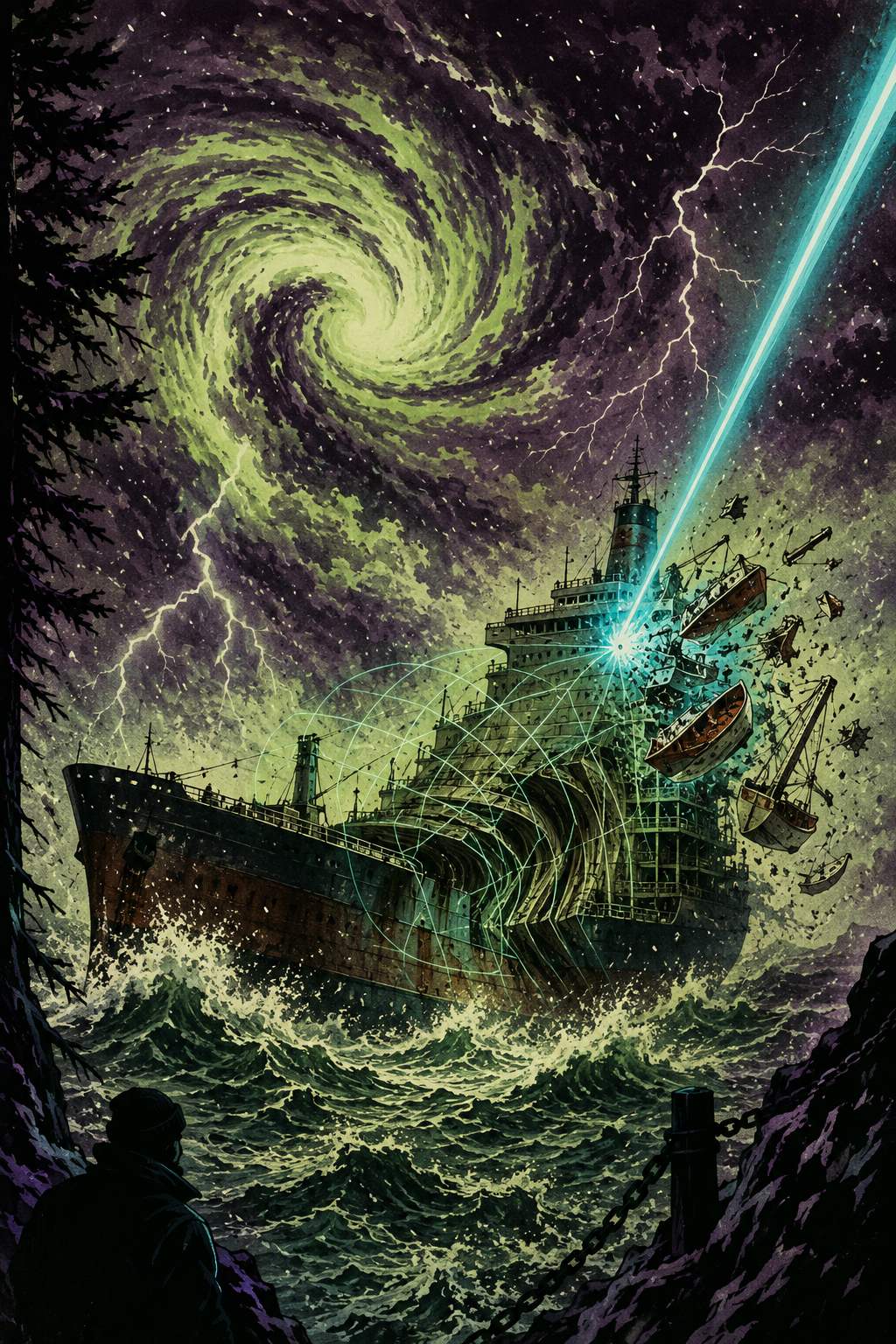
A Directed Energy Weapons (DEW) Attack fully describes all known evidence, including all anomalies. Why it was done, and by whom, remain unknown, but the evidence itself leaves all other theories, stories and explanations insufficient (and thus false) due to their inability to fully explain any of the many anomalies.
To understand how an advanced electromagnetic framework could account for the specific physical anomalies found at the Edmund Fitzgerald wreck site, we must first map the baseline environmental engine that powered the event: The Great Lakes Cyclone of November 9–11, 1975.
The storm that crossed Lake Superior is colloquially remembered as the “Witch of November,” but meteorologically, it was a classic Panhandle Hook that transformed into an explosive bomb cyclone.
Intensity & Pressure: The system organized over central Kansas on November 9 with a standard pressure of 1000 mb. As it hooked northeast toward the Great Lakes, it deepened drastically. By the afternoon of November 10, as it crossed directly over Marquette, Michigan, its central barometric pressure plummeted to 982 mb (and eventually hit 978 mb over James Bay). This rapid drop of over 24 mb in 24 hours satisfies the exact definition of meteorological “explosive cyclogenesis.”
The Wind & Wave Dynamics: This extreme pressure differential generated sustained winds of 50–60 knots (58–69 mph) with verified hurricane-force gusts topping 86 mph (75 knots). This massive atmospheric hammer whipped up significant wave heights of 18 to 25 feet, with rogue “Three Sisters” wave sets estimated to exceed 35 feet.
The Ultra-High Voltage Gradient
From an unconventional forensic perspective, a bomb cyclone of this magnitude is not just a wind event; it is a massive, spinning electrostatic generator.
The friction of freezing rain, heavy snow squalls, and intense baroclinic layering within the storm’s core forces massive charge separation between the upper troposphere and the lake’s surface. This creates a natural, localized ultra-high voltage atmospheric gradient.
Under standard conditions, this energy discharges as lightning. However, if a phased, military-grade radar network (like the WSR-57 array or SAC base emitters) locks onto that gradient, the storm’s raw electrostatic voltage can be focused and stabilized into a continuous-wave standing resonance.
The Destruction of the Lifeboats: Particle Beam Ionization
The Fitzgerald’s two commercial lifeboats were found floating in the debris field, but they weren’t just waterlogged—they were shattered, torn from their heavy launch davits, and structurally mangled.
If a high-energy particle beam (such as a neutral particle beam or a focused proton stream leveraged via leased beam-time infrastructure) were projected through the storm’s polarized atmospheric gradient, the interaction with ambient matter would be instantaneous:
Air-Coupled Ionization: As the particle beam cuts through the storm’s hyper-dense snow squalls, it leaves a highly ionized, conductive plasma channel in its wake.
The Thermal Shockwave: When this plasma channel grounds out against the metallic structure of the Fitzgerald, the localized energy dump doesn’t function like a slow heating element. It acts like a kinetic blast.
Mechanical Severance: The lifeboats, stored on the aft superstructure, are exposed. The extreme, instantaneous thermal expansion caused by the beam striking the aluminum hulls and steel davits would flash-vaporize any moisture in the fittings. The resulting micro-explosions would violently shear the mechanical couplings, tearing the lifeboats from their mounts and splitting their hulls before they ever touched the water.
Warping and Wilting: The Macro-Hutchison Effect
The most glaring forensic mystery of the Fitzgerald wreckage is that the midsection was completely obliterated, while the bow and stern sit on the lake bed 530 feet below, separated by a field of highly deformed steel. The metal plates weren’t just broken; they were twisted, curled, and structurally “wilted.”
This exact signature matches the material anomalies documented in the Hutchison Effect, where the intersection of complex RF fields and high-voltage gradients alters the crystalline structure of metals.
Intergranular Dissociation: Steel relies on a rigid crystalline lattice of iron and carbon atoms. When the Mighty Fitz’s 26,116-ton payload of magnetic taconite ore became hyper-charged by the focused standing waves of the radar grid, it turned the entire midsection into an immense electromagnetic induction core. Perhaps as each molecule was stripped from its lattice-neighbors and set into chaos, ‘like charges repel’ phenomenon took hold and the ‘disintegration’ was rapidly, violently fomented; not necessarily an all-out explosion, rather more of a contained, thorough blast.
The “Wilting” Phase: The overlapping RF frequencies disrupted the electron bonds holding the steel’s crystalline grain boundaries together. Without raising the temperature of the steel to its melting point, the metal lost its structural modulus. It became soft, plastic, and malleable—literally “wilting” under the weight of the ship.
The Structural Collapse: As the steel girders turned to a putty-like consistency via molecular dissociation, the hydrostatic pressure of the lake and the weight of the cargo tore the midsection apart. The steel didn’t snap due to kinetic stress alone; it was electronically softened from within, causing the ship to lose all longitudinal rigidity and break in two (or three) instantly, completely explaining why the crew never had time to launch a distress signal or don lifevests.
Explore meteorology behind Great Lakes cyclones and how such extreme physical forces develop, see this analysis of The Storm That Sank the Edmund Fitzgerald. This video provides a detailed lecture on the specific weather tracking and atmospheric pressure drops recorded on November 10, 1975.